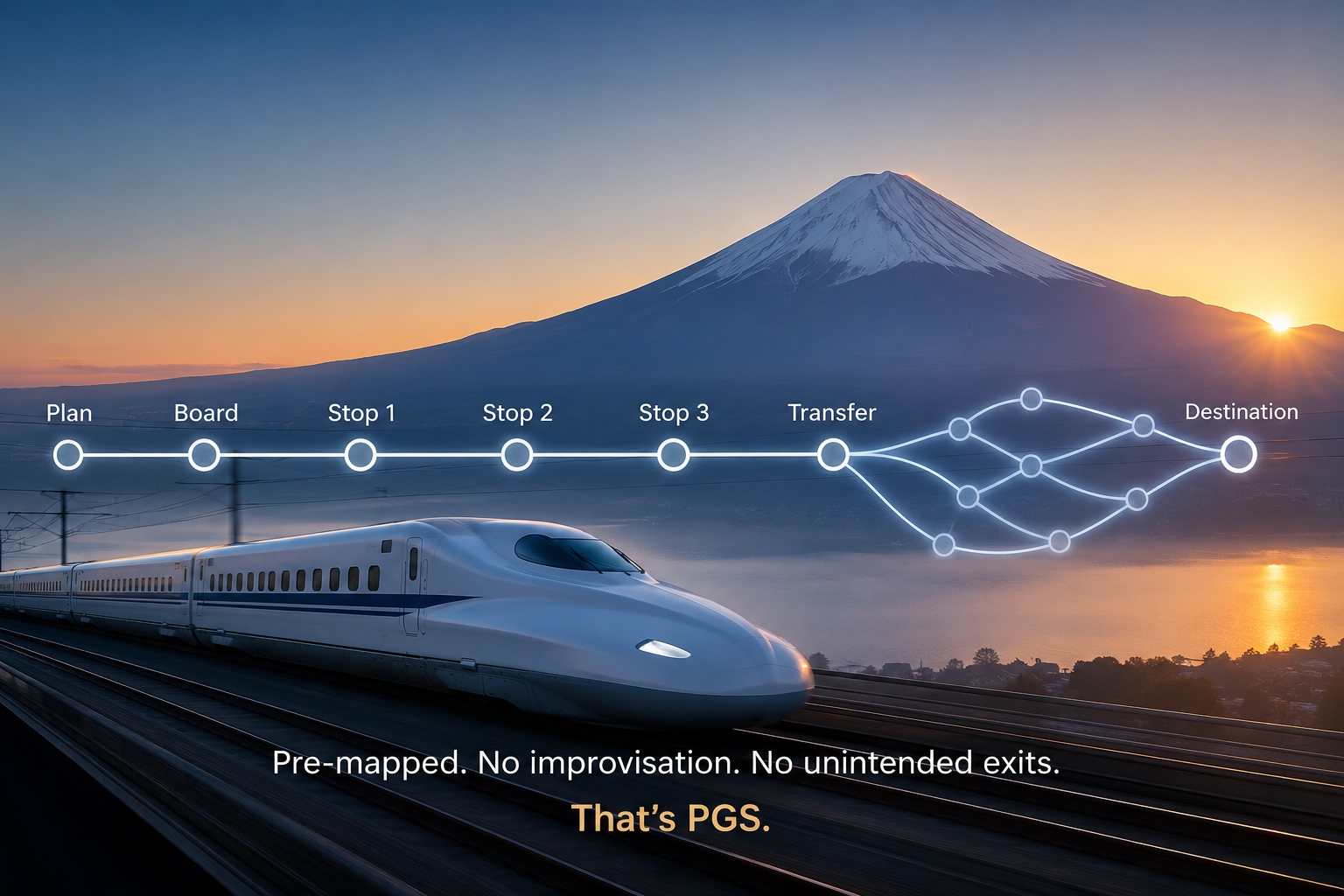
The Quiet Privilege Escalation in Enterprise AI

#05 — The Quiet Privilege Escalation in Enterprise AI

In Part 4, we showed how a constitutional governance layer sits between an agentic AI system and enterprise infrastructure — catching a $400,000 license misallocation before it happened. The mechanism was structural: undeclared behavior was architecturally impossible. But that example assumed we already understood why such a layer is necessary. This post examines the specific failure mode that makes it urgent: quiet privilege escalation — the structural pattern by which AI agents inherit authority nobody explicitly granted them. ...

February 12, 2026 · 8 min · 1632 words · Bhash Ganti

Protocol-Governed Systems: Runtime Conceptual Model

Contact: mailto:bachipeachy@gmail.com ORCID Profile: https://orcid.org/0009-0007-3810-6520 Preface This paper is part of the PGS technical paper series. The paper Protocol-Governed Systems: Conceptual Model established the architectural foundations: constitutional governance, the four-layer stack, and the separation of governance from execution. The paper Protocol-Governed Systems: Compiler Conceptual Model described how the compiler converts protocol declarations into a governed execution boundary called the Protocol Snapshot. Together, those two papers establish that behavior is fully determined before execution begins. This paper focuses on the component that consumes that boundary: the PGS runtime. ...

February 12, 2026 · 32 min · 6781 words · Bhash Ganti
I Built an AI Governance Domain in a Day

#06 — I Built an AI Governance Domain in a Day

In Part 3, I argued that agentic AI needs a constitution, not just guardrails. In Part 4, I made it concrete — showing how a constitutional governance layer between an agent and enterprise systems could structurally prevent a $400,000 license misallocation. In Part 5, I dissected quiet privilege escalation — the silent accumulation of composite authority that traditional controls were never designed to catch. Those posts defined the problem. They made the case. They laid out the architecture. ...

February 19, 2026 · 10 min · 2094 words · Bhash Ganti

Protocol-Governed Systems: Closed-Loop Governed Evolution

Contact: mailto:bachipeachy@gmail.com ORCID Profile: https://orcid.org/0009-0007-3810-6520 Preface This paper is part of the PGS technical paper series. The paper Protocol-Governed Systems: Conceptual Model established the architectural foundations: constitutional governance, the four-layer stack, and the separation of governance from execution. The paper Protocol-Governed Systems: Compiler Conceptual Model described how the compiler converts protocol declarations into a governed execution boundary called the Protocol Snapshot. The paper Protocol-Governed Systems: Runtime Conceptual Model described how the runtime consumes that snapshot and executes workflow instances without any domain knowledge. The paper Protocol-Governed Systems: Architecture Inversion Concepts established why inverting the traditional relationship between specification and implementation is a structural requirement, not a design preference. Together, those four papers establish that behavior is fully determined before execution begins and that the protocol is the sole source of behavioral truth. ...

February 19, 2026 · 49 min · 10435 words · Bhash Ganti
From Serverless Guardrails to Structural Governance

#07 — From Serverless Guardrails to Structural Governance

] In Part 6, I showed what happened when I built a complete AI governance domain in a day — from specification to deterministic trace — without modifying the execution engine. That post demonstrated something important: Governance can be structural. It can be declared first and executed mechanically. It does not need to be embedded in application code. After publishing it, several readers pointed me toward a parallel thread in the industry: the rise of “Security-First” and “Golden Path” development practices in cloud-native systems. ...

February 26, 2026 · 5 min · 1062 words · Bhash Ganti

PGS Field Manual

Status: Public Reference Artifact — v0 · Baseline: PGS v0.5.0 Canonical Repository: bachipeachy/pgs_workspace Audience: Architects · Compiler Engineers · Runtime Engineers · Governance Engineers · AI Coding Agents What This Manual Is This is a high-density architectural restoration artifact. Its purpose is to restore the correct architectural mental model of Protocol-Governed Systems in under 30 minutes — not to teach, not to document implementation, not to walk code. Intended for: system architects, compiler engineers, runtime engineers, governance engineers, AI coding agents operating under human supervision, security reviewers, technical maintainers. ...

February 26, 2026 · 41 min · 8543 words · Bhash Ganti
The Three Dividends of Protocol-Governed Systems

#08 — The Three Dividends of Protocol-Governed Systems

In the previous post, “From Serverless Guardrails to Structural Governance,” we examined how the industry is gradually moving governance into structural layers such as infrastructure templates and Golden Paths. Those practices reflect an important realization: Procedural governance does not scale. Checklists, code reviews, and guidelines work only as long as systems remain small and development speed remains human. But modern software development is changing rapidly. Infrastructure is automated. Cloud deployments are instantaneous. And increasingly, AI can generate software at machine speed. ...

March 5, 2026 · 5 min · 882 words · Bhash Ganti
Why Smart Coding Is a Double-Edged Sword

#09 — Why Smart Coding Is a Double-Edged Sword

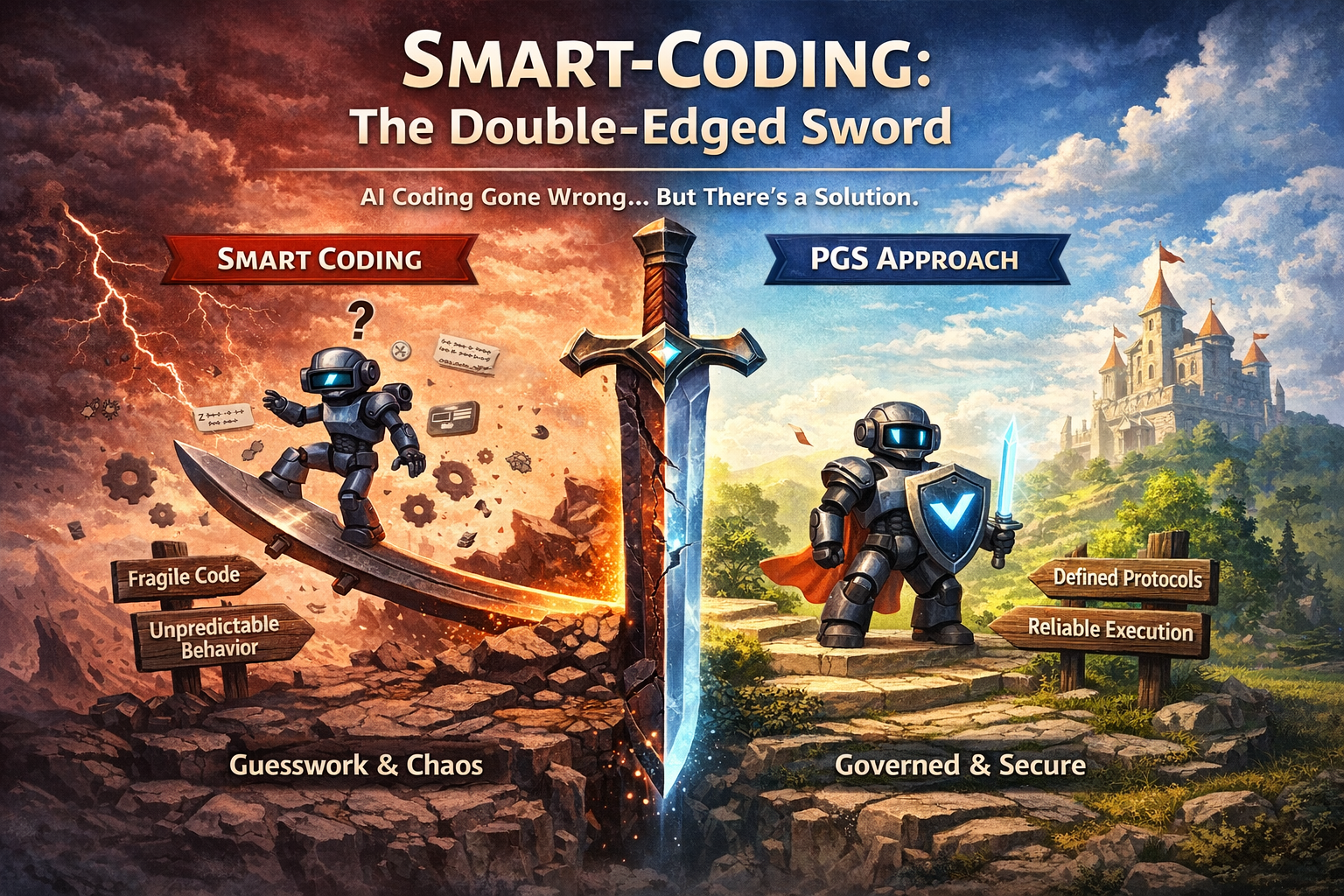
In the previous post, we explored how Protocol-Governed Systems deliver three structural dividends: governance, protocol reuse, and architectural clarity. Those dividends become even more relevant when we examine how software is now being created. Because today, a new force is reshaping development practice: AI-assisted coding. And with it, a concept that sounds entirely positive — but deserves closer examination: Smart coding. What Is “Smart Coding”? Smart coding is the practice of writing software using: ...

March 12, 2026 · 6 min · 1271 words · Bhash Ganti
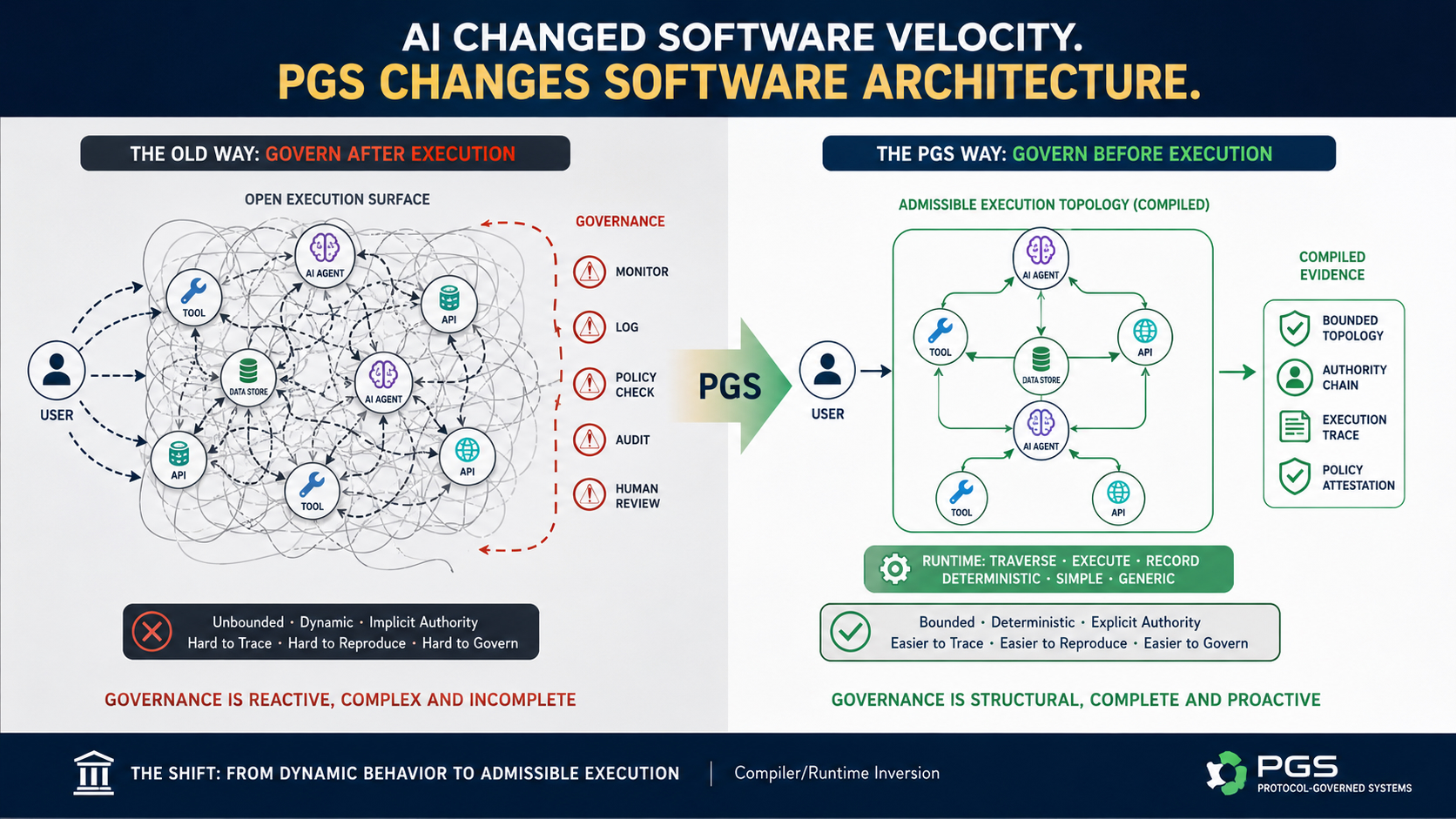
AI Accelerated Implementation. Not Governance.

#10 — AI Accelerated Implementation. Not Governance.

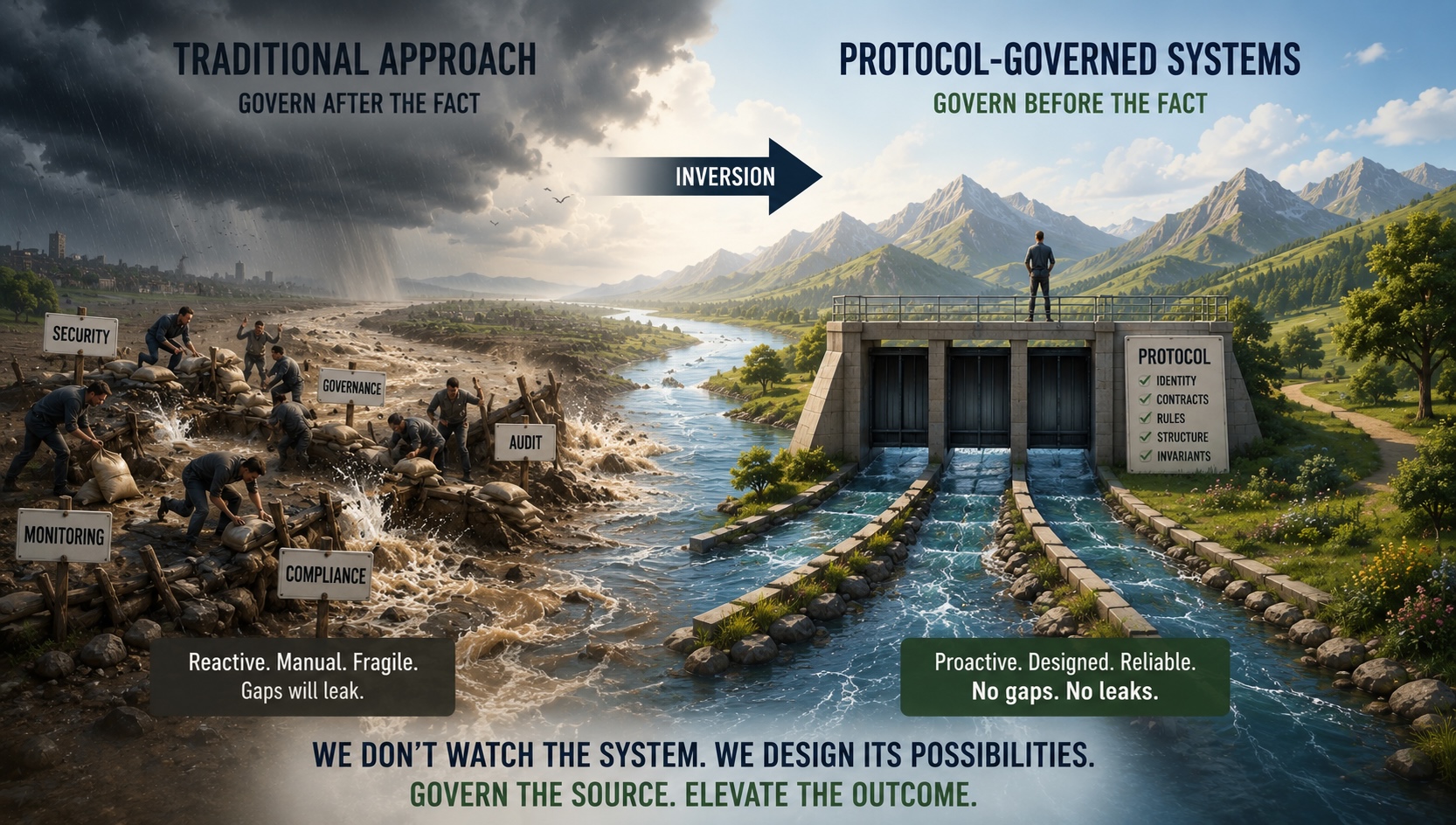
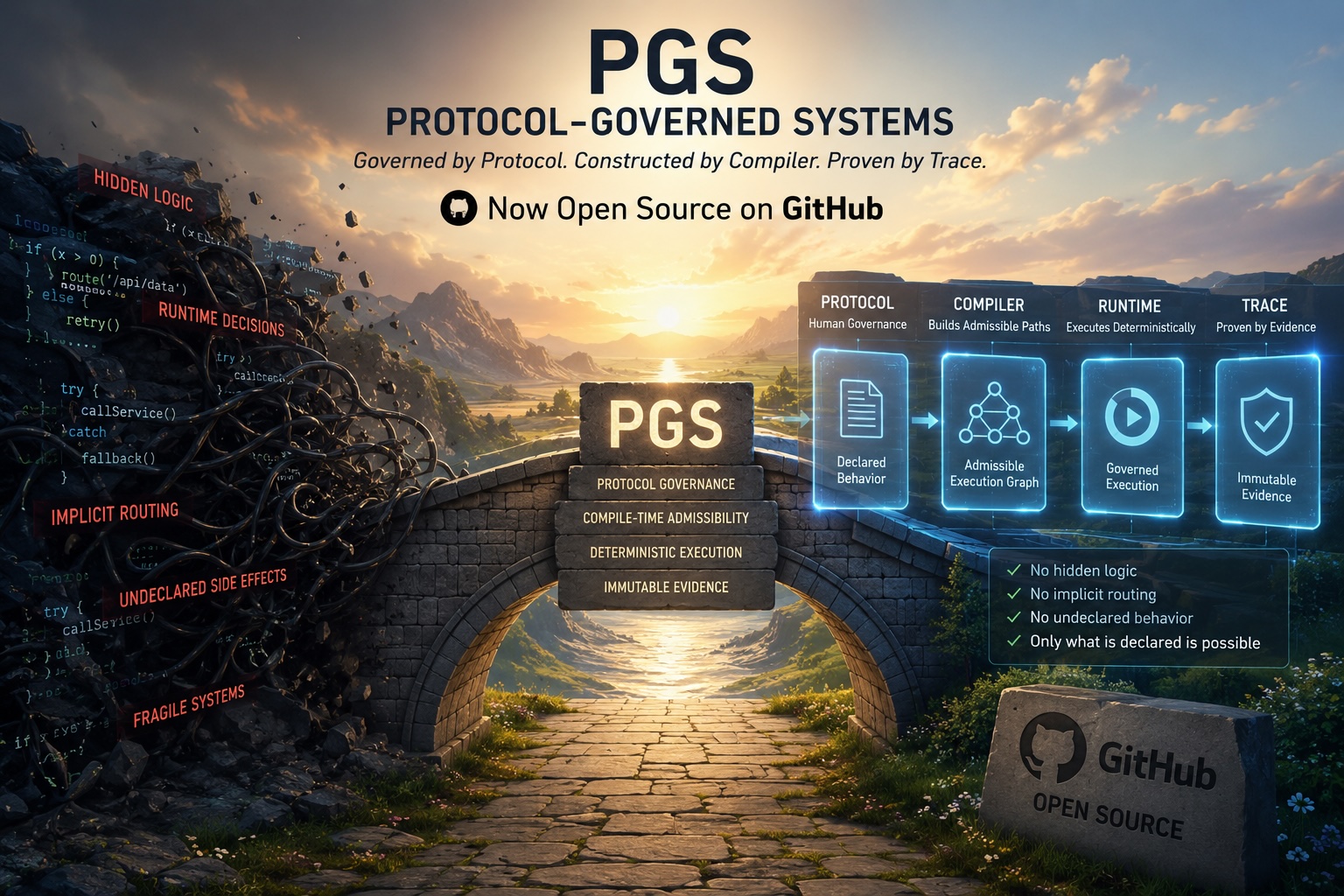
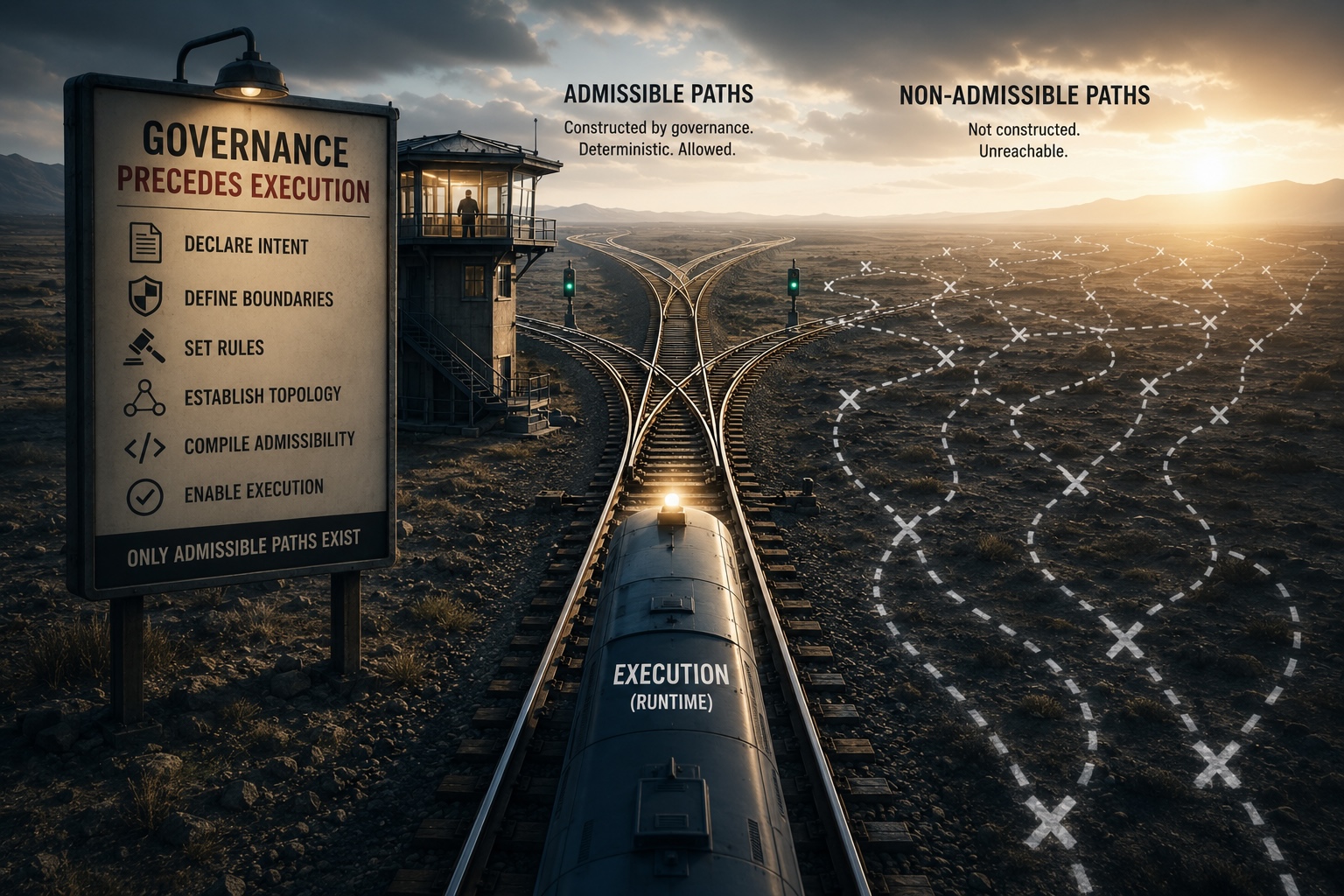
) In PGS, governance constructs the track before execution begins. AI Increased the Speed of Implementation. It Did Not Solve Governance. A protocol-first execution architecture for the AI era. Governed by Protocol. Constructed by Compiler. Proven by Trace. In the previous post, we examined how AI-assisted coding creates a double-edged sword: implementation accelerates while governance falls further behind. That gap has a name And it has structural consequences. The Governance Gap Modern software systems are extraordinarily capable at generating behavior. ...

March 19, 2026 · 7 min · 1409 words · Bhash Ganti
The EU AI Act Is Here. Your Governance Architecture Isn't Ready.

#11 — The EU AI Act Is Here. Your Governance Architecture Isn't Ready.

Why the compliance clock is ticking — and why post-hoc policy won’t survive it In the previous post, we examined how AI accelerates implementation velocity without solving governance — and how Protocol-Governed Systems invert that equation by making governance structural rather than procedural. That argument was architectural. This one is regulatory. Because the EU AI Act is no longer a proposal. It is law. And its obligations are phasing in now. ...

March 26, 2026 · 9 min · 1792 words · Bhash Ganti