Protocol-Governed Systems: Architecture Inversion Concepts

Contact: mailto:bachipeachy@gmail.com Preface This paper is part of the PGS technical paper series. The paper Protocol-Governed Systems: Conceptual Model established the architectural foundations: constitutional governance, the four-layer stack, and the separation of governance from execution. The paper Protocol-Governed Systems: Compiler Conceptual Model described how the compiler converts protocol declarations into a governed execution boundary called the Protocol Snapshot. The paper Protocol-Governed Systems: Runtime Conceptual Model described how the runtime consumes that boundary and executes governed behavior without containing any domain knowledge. ...
January 22, 2026 · 37 min · 7684 words · Bhash Ganti

Protocol-Governed Systems: Closed-Loop Governed Evolution

Contact: mailto:bachipeachy@gmail.com Preface This paper is part of the PGS technical paper series. The paper Protocol-Governed Systems: Conceptual Model established the architectural foundations: constitutional governance, the four-layer stack, and the separation of governance from execution. The paper Protocol-Governed Systems: Compiler Conceptual Model described how the compiler converts protocol declarations into a governed execution boundary called the Protocol Snapshot. The paper Protocol-Governed Systems: Runtime Conceptual Model described how the runtime consumes that snapshot and executes workflow instances without any domain knowledge. The paper Protocol-Governed Systems: Architecture Inversion Concepts established why inverting the traditional relationship between specification and implementation is a structural requirement, not a design preference. Together, those four papers establish that behavior is fully determined before execution begins and that the protocol is the sole source of behavioral truth. ...

February 19, 2026 · 57 min · 12115 words · Bhash Ganti

Protocol-Governed Computing: An Architecture for Closed-Loop Governed Transformation

© 2026 Bhash Ganti Contact: bachipeachy@gmail.com ORCID Profile: https://orcid.org/0009-0007-3810-6520 Preface Software changes continuously, yet software engineering has traditionally treated construction, execution, and evolution as largely separate concerns. This paper presents an architecture for software evolution—how running software changes over time while remaining governed, verifiable, and executable—in an era in which AI and LLM-based coding assistants can automate software implementation at increasing scale. When implementation can be generated, modified, and regenerated automatically, the question of who governs the act of change becomes the architectural question. It is the second of three companion papers: the first addresses deterministic declarative execution [Ganti, 2026l], and the third addresses realization of the architecture as a functioning normative platform [Ganti, 2026m]. ...

August 11, 2026 · 76 min · 16099 words · Bhash Ganti
A Draft Open Standard for Protocol-Governed Computing

#22 — A Draft Open Standard for Protocol-Governed Computing

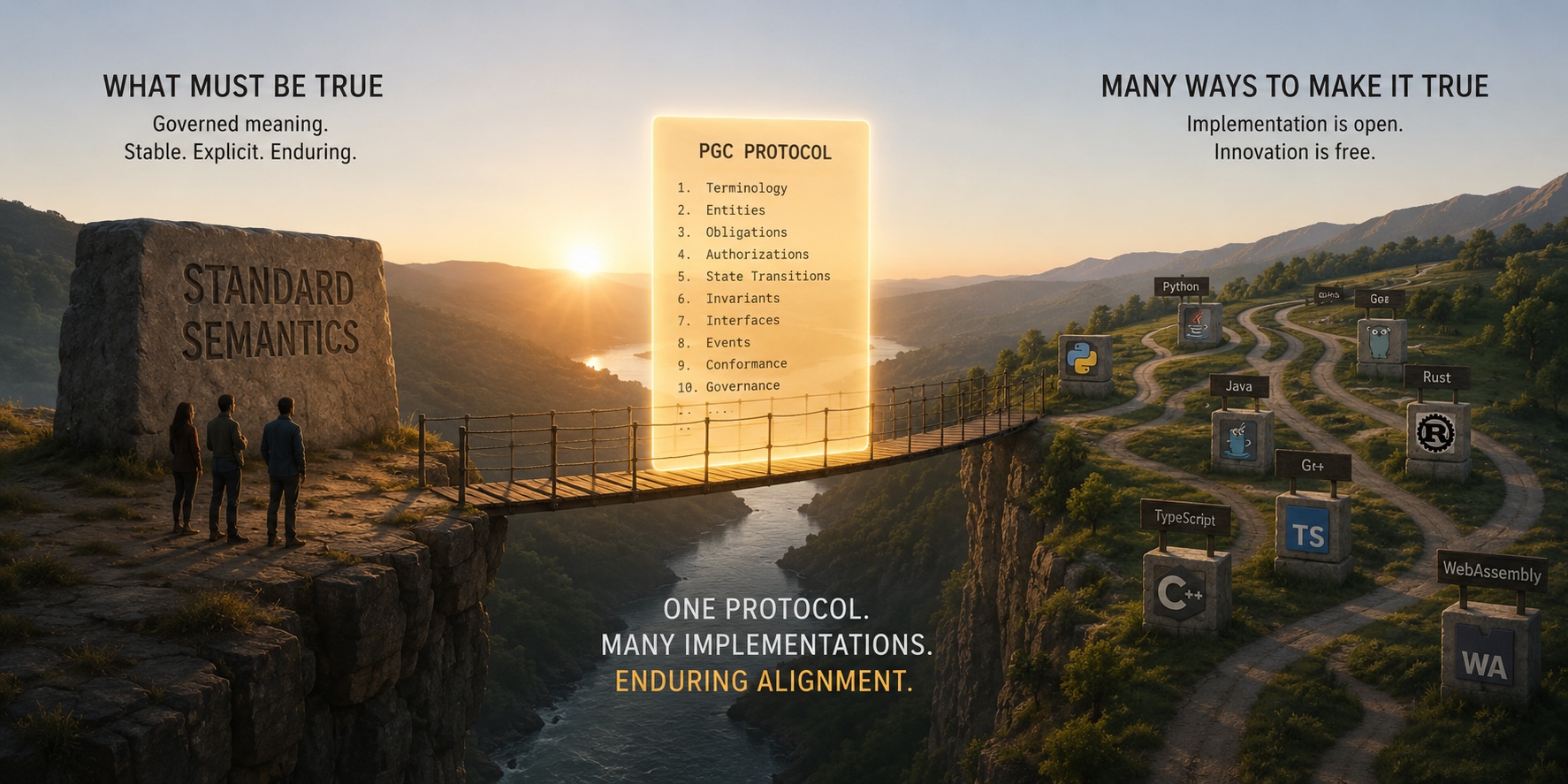
The first open draft of the Protocol-Governed Computing (PGC) Standard is now available for public scrutiny. It is an attempt to address a problem that becomes increasingly expensive as business software grows older: how to preserve the governing meaning of a system while allowing its implementation to change. That picture is the whole idea in one frame. On the left, the governed meaning of a system: stable, explicit, written down. On the right, every language and runtime anyone might choose to realize it in. The protocol is the bridge, and it is deliberately narrow — it says what must be true, and says nothing about which road you take to make it true. ...

August 23, 2026 · 9 min · 1776 words · Bhash Ganti

Protocol-Governed Computing: Realizing the Normative Platform and Its Governed Transformation

© 2026 Bhash Ganti. All rights reserved. Bhash Ganti (aka Bachi) Contact: bachipeachy@gmail.com ORCID Profile: https://orcid.org/0009-0007-3810-6520 Companion papers Part 1 — Protocol-Governed Computing: An Architecture for Deterministic Declarative Execution. https://doi.org/10.5281/zenodo.21879516 Part 2 — Protocol-Governed Computing: An Architecture for Closed-Loop Governed Transformation. https://doi.org/10.5281/zenodo.21879948 Abstract Two companion papers establish the architecture of protocol-governed computing. One defines execution as declarative traversal of a compiled protocol; the other defines evolution as the governed transformation of one executable baseline into the next. Both state what must be true. Neither states what it takes to make it true, nor how one would know it had been achieved. ...

August 11, 2026 · 54 min · 11363 words · Bhash Ganti

Protocol-Governed Computing: Field Manual

Author: Bhash Ganti (aka Bachi) © 2026 Bhash Ganti. All rights reserved. Released under the Apache-2.0 License. Audience: architects · compiler engineers · runtime engineers · governance engineers · AI coding agents under human supervision What this manual is A high-density restoration artifact. Its purpose is to rebuild the correct mental model of Protocol-Governed Computing in under thirty minutes — not to teach it, not to document code, not to walk a codebase. ...

August 22, 2026 · 32 min · 6791 words · Bhash Ganti

Protocol-Governed Systems: Architecture Inversion Concepts

(c) 2026 Bhash Ganti Contact: mailto:bachipeachy@gmail.com ORCID Profile: https://orcid.org/0009-0007-3810-6520 Revision v1. Two changes, neither altering a claim of the paper. The preface was reframed so the paper reads as an entry point rather than as the fourth of a series, which is the role it now serves. A note on the change of name from Protocol-Governed Systems to Protocol-Governed Computing was added. The fifteen inversions and their development are unchanged from v0. ...

August 11, 2026 · 37 min · 7826 words · Bhash Ganti

Protocol-Governed Systems: A Conceptual Model

(c) 2026 Bhash Ganti Bhash Ganti Contact: bachipeachy@gmail.com Purpose: Define the conceptual model for Protocol-Governed Systems, validated through the PGS reference implementation. Audience: Protocol designers, compiler authors, runtime implementers, conformance engineers Abstract Protocol-Governed Systems (PGS) propose a computational architecture in which governance precedes execution. Instead of relying on runtime policies, conventions, or post-hoc validation, PGS defines admissible behavior through governed protocol artifacts that are compiled into deterministic execution structures before runtime begins. ...

January 29, 2026 · 33 min · 7005 words · Bhash Ganti

Protocol-Governed Systems: A Constitutionally Constrained Architecture for Autonomous and AI-Generated Software

© 2026 Bhash Ganti. All rights reserved. Bhash Ganti (aka Bachi) Contact: bachipeachy@gmail.com Abstract The rapid acceleration of AI-assisted software generation exposes a fundamental limitation in conventional software architecture: behavior is implicitly defined by implementation, while governance operates reactively and at human speed. This mismatch creates a structural gap in which systems can exhibit unauthorized, non-deterministic, and unauditable behavior. Existing approaches — static analysis, runtime guardrails, policy engines — attempt to constrain behavior after code is produced, but cannot guarantee compliance when implementation evolves faster than governance capacity. ...

January 15, 2026 · 47 min · 9905 words · Bhash Ganti

Protocol-Governed Systems: Compiler Conceptual Model

(c) 2026 Bhash Ganti Contact: mailto:bachipeachy@gmail.com ORCID Profile: https://orcid.org/0009-0007-3810-6520 Revision v1. Two changes, neither altering a claim of the paper. A forward reference to “Paper 6 in this series” was repointed: the authoring pipeline it promised is now developed in An Architecture for Closed-Loop Governed Transformation, which supersedes the earlier treatment of governed change. A note on the change of name from Protocol-Governed Systems to Protocol-Governed Computing was added. The compiler model itself is unchanged from v0. ...

August 11, 2026 · 26 min · 5473 words · Bhash Ganti