© 2026 Bhash Ganti. All rights reserved.
Bhash Ganti (aka Bachi)
Contact: bachipeachy@gmail.com
Abstract
The rapid acceleration of AI-assisted software generation exposes a fundamental limitation in conventional software architecture: behavior is implicitly defined by implementation, while governance operates reactively and at human speed. This mismatch creates a structural gap in which systems can exhibit unauthorized, non-deterministic, and unauditable behavior. Existing approaches — static analysis, runtime guardrails, policy engines — attempt to constrain behavior after code is produced, but cannot guarantee compliance when implementation evolves faster than governance capacity.
This paper introduces Protocol-Governed Systems (PGS), a computational architecture in which behavior is defined explicitly through governance artifacts and compiled into deterministic execution graphs prior to runtime. PGS establishes a strict boundary between intent and execution via a dedicated Compiler Subsystem that derives orchestration structure from protocol declarations, while computation remains implemented in conventional programming languages. Execution is constrained by a constitutionally defined model that separates pure computation from governed mutation and requires all externally observable effects to be explicitly enumerated and authorized.
Within this model, code possesses no inherent authority; all privileges originate from protocol declarations and are enforced during execution. As a result, execution paths that violate declared protocol constraints cannot be constructed within the system, yielding constitutionally admissible execution by construction. This structural property replaces ambient authority with a zero-authority baseline and enables deterministic trace generation, replayable execution semantics, and complete auditability of externally observable behavior.
This paper builds on the conceptual model defined in [Ganti, 2026b], which establishes PGS as a constitutional execution substrate, defines the protocol snapshot as the immutable admissibility boundary, formalizes compositional admissibility across four architectural layers, and states the constitutional invariants governing execution behavior. The present paper extends that foundation with a complementary operational perspective — the Dual-Space Model — formalizes the execution semantics, demonstrates that entire classes of security vulnerabilities are structurally unrepresentable, and validates the architecture’s linear governance scalability through theoretical analysis and empirical evidence from the OmniBachi reference implementation.
PGS demonstrates that governance complexity scales linearly with system growth by replacing O(N × M) pairwise implementation dependencies — where N denotes the number of distinct capabilities and M denotes the number of workflows composing those capabilities — with protocol-mediated capability interfaces, reducing lifecycle complexity to O(N + M). We also show that these constraints preserve computational expressiveness through underlying CT (Capability Transform) and CS (Capability Side Effect) implementations while maintaining bounded orchestration topology, ensuring that governance rigor does not limit the computational power available within governed capability boundaries.
Protocol-Governed Systems redefine software construction as a compiler-mediated process in which behavior is specified prior to implementation and execution is constructed by the compiler from governance artifacts rather than authored directly. The architecture enables the generation of complete execution graphs at compile time — without requiring the execution of underlying implementations — while simultaneously validating conformance to constitutional constraints. This establishes a form of structurally governed execution in which behavioral admissibility is determined prior to runtime. The paradigm provides a foundation for building high-velocity, governable systems in environments where implementation is increasingly autonomous and ephemeral.
1. Introduction
1.1 The Governance Crisis in High-Velocity Software
Software systems are entering a regime in which the velocity of implementation is no longer bounded by human effort. Modern development workflows increasingly rely on automated code generation, synthesis tools, and large language models capable of producing substantial portions of production code. As a result, implementation artifacts can be created, modified, and replaced at a rate that exceeds the capacity of human-driven validation and governance.
This creates what we term the generation-governance impedance mismatch. Let V_g denote the velocity of implementation generation and V_gov denote the velocity at which governance mechanisms can validate and constrain behavioral change. In conventional systems, governance assumes V_g ≤ V_gov. In AI-accelerated environments, this assumption no longer holds: V_g >> V_gov.
This inequality produces three systemic failure modes:
Behavioral Drift: Implementation evolves independently of governance constraints, introducing unauthorized behavior. Because behavior is defined by code, drift is often undetectable until runtime.
Audit Infeasibility: When execution depends on non-deterministic code paths and implicit state interactions, reproducing system behavior becomes infeasible. This limitation is compounded when the implementation responsible for a behavior may no longer exist when analysis is required.
Ambient Authority: Implementation inherits authority from its execution environment rather than from explicit declarations, enabling privilege escalation through code structure rather than through governed capability.
Definition (Behavior): For the purposes of this paper, behavior is defined as the set of externally observable effects produced by a system, together with the causal execution trace that leads to those effects, independent of the semantic implementation details of the underlying code.
1.2 Why Reactive Governance Approaches Fail
Existing governance mechanisms attempt to constrain behavior after implementation exists:
Static Analysis attempts to detect violations by inspecting code structure, but cannot guarantee conformance to intended behavior when implementations are generated or mutated dynamically. It answers “what might go wrong?” rather than “what is permitted?”
Runtime Guardrails intercept execution to enforce policy constraints but operate as post-hoc filters on unconstrained execution. They introduce performance overhead and cannot eliminate unanticipated behavior paths.
Policy Engines externalize rules but remain coupled to implementation semantics. They depend on correct instrumentation of code and assume that behavior can be reliably observed and constrained at runtime.
Formal Verification can prove properties of specific implementations but does not scale when implementations are continuously generated or replaced.
These approaches share a common limitation: they attempt to constrain unconstrained artifacts. As long as implementation remains the source of behavior, governance remains reactive, incomplete, and fundamentally non-scalable.
1.3 The Case for Protocol-Governed Execution
Resolving the generation-governance impedance mismatch requires a structural inversion: behavior must be defined independently of implementation and enforced prior to execution.
This implies three necessary properties:
Behavioral Preemption: All permissible behavior must be declared before execution. Implementations must operate within a pre-defined behavioral space rather than defining it dynamically.
Enumerated Authority: All externally observable effects must be explicitly declared and bounded. No execution context may grant implicit or ambient authority.
Deterministic Enforcement: Execution must be constrained such that only behavior conforming to declared specifications can occur. Enforcement must not depend on runtime interpretation or post-hoc validation.
The critical architectural requirement is a mechanism that transforms declared behavior into enforceable execution structure before runtime. This role is fulfilled by the Compiler Subsystem, which acts as an enforcement boundary between intent and execution by:
- Constructing execution graphs from protocol artifacts
- Validating structural correctness and dependency resolution
- Rejecting invalid or non-conformant behavior prior to execution
This transformation is performed without requiring the execution of underlying implementations, ensuring that behavioral admissibility is determined independently of code. As a result, only behavior that can be constructed from valid protocol declarations can be executed.
Consider a constitutional rail network: governance defines the railway law; the compiler lays the track; the runtime is the train. Railway law may declare, for example, that hazardous cargo cannot enter civilian districts, international freight must pass through customs junctions, and military routes remain isolated from public transit lines. The compiler materializes only rail topology that satisfies those constraints. The runtime train does not need to understand its cargo or destination semantics — it only follows constructed rail. Unauthorized destinations are unreachable not because guards block them dynamically, but because no legal track leads there. This metaphor will recur as the architecture is formalized below.
1.4 Research Question and Contributions
This paper addresses the following research question:
How can software execution remain governable when implementation is autonomous, ephemeral, or evolves faster than governance capacity?
We argue that this requires a fundamental shift from code-centric execution models to protocol-governed execution, where behavior is defined, validated, and enforced independently of implementation.
We introduce Protocol-Governed Systems (PGS) as a computational architecture that achieves this separation. The conceptual model — defining PGS as a constitutional execution substrate, the protocol snapshot as an immutable admissibility boundary, compositional admissibility across four architectural layers, and the constitutional invariants — is established in [Ganti, 2026b]. The present paper extends that foundation with four contributions:
1. The Dual-Space Operational Model
We introduce a complementary perspective on the conceptual model’s four-layer architecture [Ganti, 2026b, Section 1.2] — the Dual-Space Model — which separates the system into the Human Governance Space and the Machine Execution Space. This perspective illuminates the operational separation between governance authoring and deterministic execution, providing an intuitive frame for understanding how the four architectural layers map to distinct operational domains.
2. Compile-Time Behavioral Enforcement
We introduce the Compiler Subsystem as a first-class architectural primitive that constructs deterministic execution graphs from protocol artifacts, validates structural and dependency correctness, and determines behavioral admissibility without executing implementation code, rendering the execution model semantic-agnostic — meaning admissibility and topology enforcement do not depend on implementation semantics. Implementation logic may still produce semantically incorrect results within its authorized capability boundary. This enables structurally governed execution by construction, where behavior outside the admissibility boundary cannot be expressed in executable form.
3. Security Inversion Principle
We formalize a security model in which code possesses no inherent authority; all privileges originate from explicit protocol declarations; and execution is constrained by enumerated capability boundaries. This eliminates ambient authority and ensures that unauthorized execution topology is structurally unconstructible within the admissibility graph.
4. Linear Governance Scalability
We demonstrate that governance complexity scales as O(N + M) where N is the number of distinct capabilities and M is the number of workflows composing those capabilities. This is achieved by replacing O(N × M) pairwise implementation dependencies with protocol-mediated capability interfaces, decoupling behavioral specification from implementation.
2. Background and Related Work
Protocol-Governed Systems draws upon multiple established traditions in computer science. These traditions provide critical foundations but none resolve the generation-governance impedance mismatch (V_g >> V_gov). A common limitation is that they assume implementation as the primary carrier of behavior, requiring governance mechanisms to interpret, analyze, or constrain implementation artifacts. PGS introduces a shift to semantic-agnostic execution, where governance operates on explicitly declared protocol structures rather than inferred implementation semantics.
2.1 Functional Programming and Effect Systems
Functional programming introduced referential transparency, ensuring that functions produce consistent outputs for given inputs and avoid side effects. Languages such as Haskell enforce purity through type systems, separating pure computation from effectful operations. Effect systems extend type systems to track computational effects such as I/O, state mutation, and exceptions.
Limitation: Functional purity is primarily a linguistic property dependent on source-level correctness and language semantics. In AI-generated environments where implementations may be transient or machine-authored, such guarantees are insufficient.
PGS Shift: PGS elevates purity from a language feature to an architectural invariant [Ganti, 2026b, invariant E2]. Purity is enforced structurally rather than syntactically, making the implementation language irrelevant. Even impure code becomes operationally pure within the execution environment. This establishes implementation-independent purity enforcement, where correctness does not depend on understanding or trusting implementation semantics.
2.2 Capability-Based Security
Capability-based security replaces ambient authority with explicit, unforgeable tokens that grant access to resources. This model ensures that code can only act on resources for which it holds capabilities, representing a major advancement over implicit authority models.
Limitation: Traditional capability systems are often object-centric (capabilities passed dynamically at runtime), dynamically distributed, and difficult to reason about globally at scale. As systems grow, capability relationships form complex graphs, reintroducing coupling and limiting scalability.
PGS Shift: PGS introduces protocol-centric capabilities: Capabilities are declared in governance artifacts (Capability Contract CC_ and Capability Side Effects CS_), authority is defined at compile time (not distributed at runtime), and capability invocation is structurally constrained by workflows. This enables global reasoning over authority, the elimination of hidden capability propagation, and direct support for linear governance scalability (O(N + M)).
2.3 Formal Specification and Verification
Formal methods, such as TLA+, separate specification from implementation and enable reasoning about system correctness. These approaches provide strong guarantees for design-time verification.
Limitation: Formal specifications are typically non-executable artifacts, separate from runtime systems, and expensive to maintain under continuous change. They describe behavior but do not enforce it directly.
PGS Shift: PGS transforms specification into executable governance. Protocol artifacts are compiled into execution structure; the Compiler Layer enforces correctness before runtime; and behavior is constructed under constraint rather than verified post-hoc. This represents a shift from implementation correctness to behavioral admissibility.
2.4 Positioning Statement
PGS does not replace prior paradigms — it composes and extends them by shifting the locus of correctness from implementation semantics to protocol-defined admissibility, enforced through compile-time construction rather than post-hoc inspection of code. By decoupling behavioral identity from implementation identity, PGS ensures that even as the code responsible for an action is regenerated or replaced, the governance relationship remains persistent, enforceable, and auditable. Governance survives the temporal decay of implementation.
3. Protocol-Governed System Model
This section defines PGS not as a collection of components, but as a coherent computational model in which behavior is explicitly declared, structurally constructed, and deterministically enforced independent of implementation.
PGS distinguishes semantic sovereignty from implementation responsibility. Federation boundaries govern semantic authority, publication scope, and constitutional ownership, while implementation subsystems provide materialization, execution, and tooling infrastructure. These axes are orthogonal and intentionally decoupled.
3.1 The Four-Layer Architecture
The foundational architectural model for PGS is the four-layer model defined in [Ganti, 2026b, Section 1.2], which separates the system into layers ordered by semantic dependency:
Layer 1 — Constitutional Governance: Invariants, axioms, federation boundary definitions. The fb.* namespace governs the constitutional rules that apply to federation boundary definitions themselves. This is the source of all constitutional authority.
Layer 4 — Governed Execution Protocols: Domain protocol definitions — the artifacts (WF_, CC_, CT_, CS_, IN_, AC_, TI_, TE_, EV_) that declare admissible behavior within federation boundaries. Layer 4 is constrained by Layer 1.
Layer 2 — Compiler / Snapshot: Validates Layer 4 definitions against Layer 1 constitutional governance, resolves dependencies, and produces the protocol snapshot — a verified, read-only artifact bundle that encodes all admissible execution topologies. The snapshot is the immutable admissibility boundary between governance and execution.
Layer 3 — Runtime Execution: Generic DAG traversal with zero domain knowledge. Reads the snapshot, enforces topology, produces traces. The runtime has no knowledge of protocol semantics — it is purely structural.
Evidence Projection (orthogonal): Derivative, append-only, attestational. Output of Layer 3 execution. Never input to any layer. Traces and admissibility attestations.
Layer numbering reflects semantic dependency order, not execution chronology. Layer 1 constrains Layer 4, which is compiled by Layer 2, producing the snapshot consumed by Layer 3.
PGS-Protocol specifically names Layers 1 and 2 together: the constitutional governance layer and the artifact grammar / compilation contract that it governs. It is the meta-level — what makes a protocol definition valid and what a runtime must do to be conformant [Ganti, 2026b, Section 1.2].
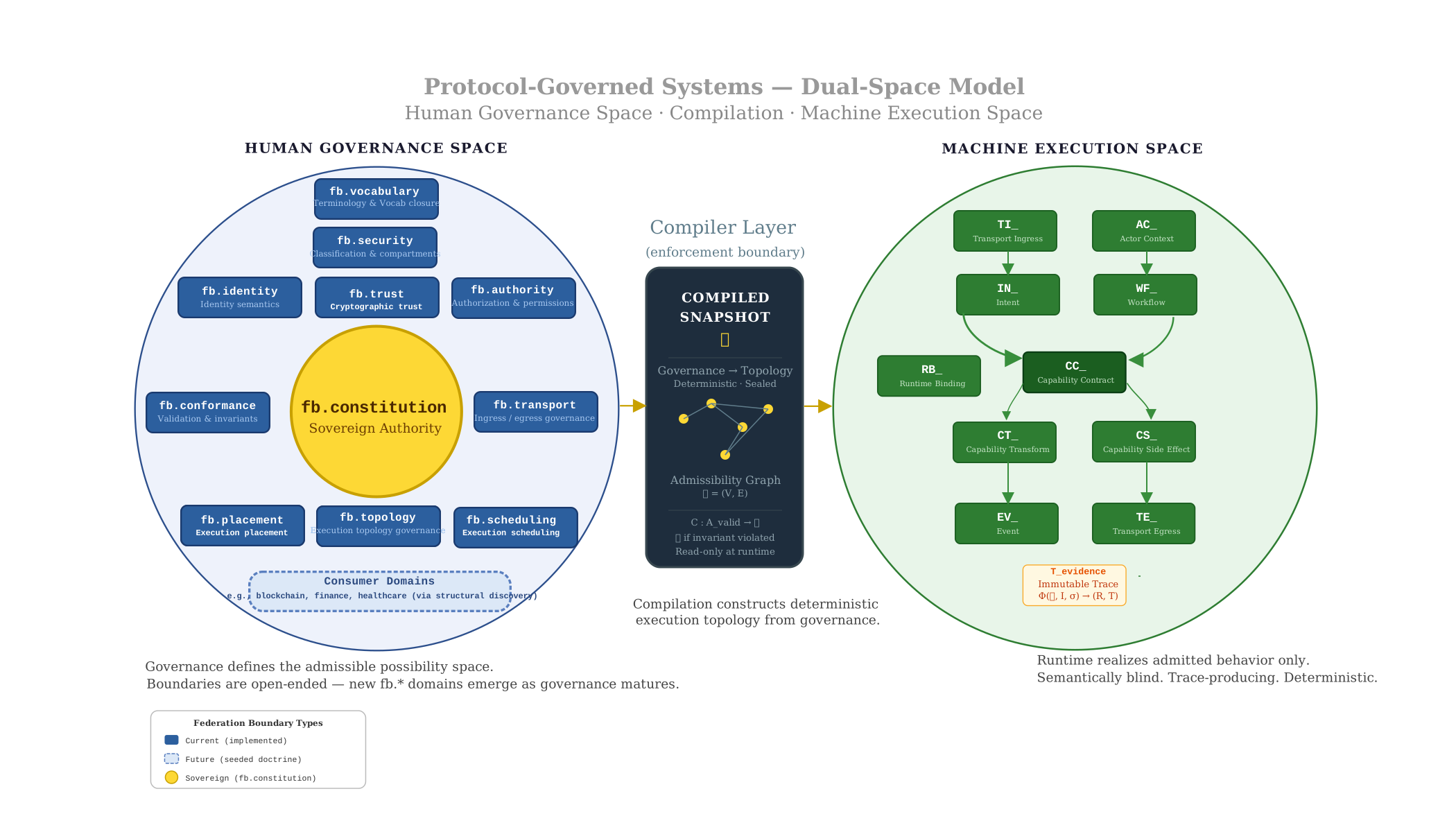
3.2 The Dual-Space Model: An Operational Perspective
The four-layer model describes architectural dependency — which concerns constrain which. The Dual-Space Model provides a complementary perspective: it describes the operational separation between the human-facing and machine-facing domains of a Protocol-Governed System.
Traditional software architecture is effectively flat: governance, authority, orchestration, control flow, and implementation are collapsed into a single operational space where behavior emerges implicitly from code. As systems evolve, this coupling causes behavioral drift, unbounded execution reachability, hidden authority propagation, and non-deterministic operational complexity.
Protocol-Governed Systems introduce a fundamentally different architectural model by separating software into two distinct operational spaces:
- The Human Governance Space
- The Machine Execution Space
This separation maps directly to the four-layer architecture:
Operational Space Layers Activity
Human Governance Space Layer 1 + Layer 4 Constitutional governance and protocol authoring
Admissibility Boundary Layer 2 output Compiled, verified, (snapshot) read-only artifact bundle
Machine Execution Space Layer 3 Deterministic traversal of compiled topology
Evidence Projection Orthogonal Append-only execution witness
The Human Governance Space
The Human Governance Space is the semantic and constitutional domain of the system. It encompasses Layer 1 (constitutional governance — invariants, axioms, federation boundaries) and Layer 4 (governed execution protocols — domain-specific artifact definitions).
Within this space, humans author declarative behavioral specifications as protocol artifacts rather than directly authoring executable control flow. These declarations govern the admissible possibility space from which deterministic execution topology may later be constructed through compilation.
In simpler terms: the Governance Space acts like constitutional law for the system — it determines what kinds of behavior may legally exist before any execution begins.
The Governance Space contains multiple orthogonal governance axes. These governance axes are formalized through bounded federation governance domains identified by fb.* Federated Boundary codes. Like constitutional ministries or sovereign governance domains, each fb.* boundary governs exactly one orthogonal aspect of admissibility — together constituting the full authority surface of the Governance Space. Examples include:
- FB_CONSTITUTION: Root sovereign authority governing the constitutional legality of all federation boundaries through delegated governance.
- FB_EXECUTION_TOPOLOGY: Governs the execution-topology surface of Capability Contract artifacts and admissible execution reachability.
- FB_EXECUTION_PLACEMENT: Governs execution locality, substrate placement, and runtime deployment admissibility.
- FB_EXECUTION_SCHEDULING: Governs execution scheduling semantics including parallelism, synchronization, and deterministic joins.
- FB_AUTHORITY: Governs invocation authorization, execution permission semantics, and actor authority state.
- FB_IDENTITY: Governs actor identity semantics and the separation of identity from authority.
- FB_VOCABULARY: Governs protocol terminology, execution state vocabulary, and concern vocabulary closure across all PGS domains.
- FB_TRANSPORT: Governs transport ingress, transport egress, admission normalization, and projection semantics.
- FB_CONFORMANCE: Governs protocol validation, invariant enforcement, and conformance admissibility.
- FB_SECURITY_DOMAIN: Governs classification domains, compartmentalization, and secure information-flow legality.
- FB_CRYPTOGRAPHIC_TRUST: Governs snapshot signing, attestation, encryption, trust admissibility, and secure execution semantics.
Domain repositories (such as blockchain, ai_governance, finance, and other future protocol-governed systems) are governance-capable. Each domain repository may contain local constitutions, invariants, and assertions governing domain-specific semantics. Domain-specific governance law belongs in the domain repository; only universally applicable governance law belongs in pgs_governance as a central federation boundary. Domains connect to the governance model through the structural discovery layer, not through a central federation boundary created on their behalf.
Unlike the execution concerns of the Machine Execution Space, federation-boundary codes govern semantic authority, ownership scope, admissibility boundaries, trust domains, topology legality, execution placement, security constraints, and other orthogonal governance concerns that shape the admissible behavior space from which execution may later be constructed.
The number of federation-boundary axes is intentionally open-ended. Protocol-Governed Systems are designed for horizontal governance expansion, allowing new orthogonal governance domains to emerge without requiring redesign of the execution substrate. This enables future architectural growth in areas such as distributed execution, cryptographic trust, classified systems, placement governance, silicon-hosted execution, and other governance concerns not yet known at the time of system construction.
Unlike the execution concerns of the Machine Execution Space, federation boundaries are not computational primitives. They are semantic governance domains that define bounded authority, ownership, visibility, and admissibility scope.
These axes operate independently while remaining constitutionally coherent through shared governance law.
Execution cannot originate from this space directly. It must first pass through compilation, where governance declarations are transformed into deterministic execution structure.
The Machine Execution Space
The Machine Execution Space is the deterministic realization domain of the system. It corresponds to Layer 3 of the four-layer architecture — it executes only behavior that has already been admitted by the Governance Space and constructed by the compiler.
The execution substrate of PGS consists of nine canonical execution concerns:
- TI (Transport Ingress): External admission and normalization
- AC (Actor Context): Authority principal binding
- IN (Intent): Declarative operation request
- WF (Workflow): Orchestration graph
- CC (Capability Contracts): Admissible capability surfaces
- CT (Capability Transforms): Pure computation
- CS (Capability Side Effects): Governed mutation and external interaction
- EV (Events): Trace, signaling, and reactive governance feedback
- TE (Transport Egress): External projection and rendering
In addition, RB (Runtime Binding) operates as an orthogonal resolution mechanism that maps capability identities to concrete implementations without participating in behavioral authority. RB participates in realization but not admissibility [Ganti, 2026b, Section 2.6].
These concerns collectively form the computational substrate of the PGS Abstract Machine. No additional execution concerns exist outside this bounded vocabulary. The Machine Execution Space is intentionally closed under vocabulary. Its computational substrate consists exclusively of the nine canonical execution concerns, with RB operating as an orthogonal runtime resolution mechanism. New execution behavior may emerge through protocol composition, but not through the creation of new runtime concern categories. This bounded vocabulary is a foundational invariant of the PGS execution model. The Machine Execution Space is:
- deterministic
- semantically blind
- topology-constrained
- contract-driven
- bounded by compiled admissibility
The runtime does not infer behavior, construct new execution paths, interpret implementation semantics, or negotiate authority dynamically. Its role is limited to deterministic traversal of the compiled admissibility graph.
Orthogonality Between Spaces
The two spaces are orthogonal.
The Human Governance Space defines: what behavior may exist.
The Machine Execution Space defines: how admitted behavior is realized.
Neither space independently defines system behavior.
Behavior exists only when:
- Governance admits the behavior,
- Compilation constructs admissible execution topology,
- Runtime deterministically enforces traversal of that topology.
This separation produces a fundamental inversion of conventional software architecture:
Code is no longer the sovereign definition of behavior.
Instead:
- governance defines admissibility,
- compilation constructs execution structure,
- runtime realizes admitted behavior.
The compiler therefore becomes the primary enforcement boundary of the system. The compiler determines behavioral reachability by constructing the admissibility graph G. If governance does not admit a path, the compiler cannot construct it; if the compiler does not construct it, runtime execution cannot traverse it.
This establishes a critical security property:
Unauthorized behavior is structurally not constructible within the admissibility graph G.
In the constitutional rail network: no track leads to unauthorized destinations — a path the compiler did not construct is a path the runtime cannot traverse.
The figure below captures the central idea.
Dataflow-Oriented Execution
Although the Governance Space is semantic and the Execution Space is mechanical, the resulting execution model is neither procedural nor pipeline-oriented. PGS execution is fundamentally a form of deterministic governed dataflow execution.
Execution progresses through:
- dependency satisfaction,
- topology traversal,
- capability activation,
- governed message flow,
- deterministic state transitions.
Independent execution branches may execute concurrently when admissible under governance constraints, while deterministic joins preserve behavioral reproducibility.
This model naturally supports:
- single-node execution,
- federated distributed multi-node execution,
- parallel execution substrates,
- cryptographically secured execution environments,
- silicon-hosted runtimes,
without changing protocol semantics.
Architectural Consequence
The separation between Human Governance Space and Machine Execution Space, understood as the operational realization of the four-layer architectural model, produces the defining property of Protocol-Governed Systems:
Behavior is not authored directly. Behavior is constructed under governance.
This transforms software architecture from an implementation-centric discipline into a governance-constructed execution system in which:
- authority is explicit,
- behavior is enumerable,
- execution is bounded,
- traces are deterministic,
- governance survives implementation change,
- and admissibility precedes execution.
3.3 Formal Definition of the Protocol-Governed System
The four-layer architecture [Ganti, 2026b] and the Dual-Space operational perspective (Section 3.2) define the structural and operational organization of PGS. Within that architecture, the system’s functional responsibilities can be formally decomposed as a tuple:
P = (A, G, C, E, S)
where:
A (Authoring): Defines the set of protocol artifacts — declarations of behavior, structure, and capability. This corresponds to the activity within Layer 4 of the four-layer model: the creation of governed execution protocol definitions (WF_, CC_, CT_, CS_, IN_, AC_, TI_, TE_, EV_).
G (Governance): Defines a set of validation functions and constitutional invariants I_const that determine admissibility of artifacts. An artifact is admitted if and only if it satisfies all invariants. This corresponds to Layer 1 of the four-layer model: constitutional governance, including federation boundary definitions and the invariants enumerated in [Ganti, 2026b, Section 4].
C (Compiler): A transformation function C: A_valid → G mapping ratified protocol declarations into a deterministic execution graph G that encodes all admissible execution paths. This corresponds to Layer 2 of the four-layer model.
E (Execution): A deterministic runtime that enforces traversal of G, mediating all interaction between orchestration and implementation. This corresponds to Layer 3 of the four-layer model.
S (Structure): A canonical identity and resolution service that provides a unique mapping between logical identifiers and their physical representations. Structure is a cross-cutting concern within the four-layer model — it participates in compilation (Layer 2) through FQDN-based artifact resolution and in runtime (Layer 3) through canonical identity enforcement. It does not correspond to a single layer but is architecturally necessary for deterministic resolution.
The formal tuple refines the four-layer model by decomposing it into named functional responsibilities. It is not an alternative architecture but a formalization tool for reasoning about properties. The four-layer model remains the canonical architectural reference.
The formal model is intentionally closed and stable. PGS defines a bounded set of functional responsibilities required to construct and execute protocol-governed behavior. This differs fundamentally from federation-boundary governance, which is intentionally open-ended and extensible. Federation boundaries may grow horizontally as new governance concerns emerge, while the functional responsibilities (A, G, C, E, S) remain fixed as the canonical decomposition of the protocol construction and execution lifecycle.
Execution Function:
Execution in PGS is a formal function of the compiled protocol
state:
Φ(G, I, σ) → (R, T_evidence)
where G is the execution graph, I is the input payload, σ is the Actor
Context (authority principal), R is the computed result, and T_evidence
is an immutable, deterministic execution trace.
Evidence-Backed Result:
The output (R, T_evidence) is an evidence-backed result, where R
represents the outcome and T_evidence is a verifiable record proving
that R was produced through a constitutionally admissible execution
path.
Admissibility-by-Construction Property:
The compiler C is a partial function:
C : A → G
where:\
- A represents the authored behavioral space\
- G represents the admissible execution topology space\
- I_const represents the constitutional invariant set
The compiler constructs an admissible execution topology only when
authored behavior satisfies all constitutional invariants.
Formally:
∀a ∈ A :
(∀i ∈ I_const : i(a) = true) ⇒ C(a) = g ∈ G
Otherwise:
C(a) is undefined
Meaning:\
- inadmissible behavior cannot be compiled into executable topology\
- unauthorized execution structure is structurally not constructible\
- runtime traversal is restricted to compiler-admitted topology only
The compiler serves as the sole constructor of admissible behavioral reachability; runtime execution cannot introduce new paths.
The formal model P is semantic-agnostic. The Execution Layer E does not interpret or reason about implementation logic, does not rely on language semantics, and enforces only the structure defined by G. Correctness of behavior does not depend on understanding the implementation.
Semantic-agnostic execution refers to independence from implementation semantics for behavioral admissibility. It does not imply correctness of implementation logic itself; it ensures that only structurally authorized behavior can execute.
The execution substrate of PGS is intentionally vocabulary-bounded. All admissible runtime behavior must be expressible through the canonical execution concerns defined by the Machine Execution Space. New behavioral composition may emerge through protocol construction, but new categories of execution concern cannot emerge dynamically at runtime. This establishes closure of the computational substrate while preserving extensibility through governance composition.
3.4 Evidence-Backed Execution
The execution trace — not the implementation — is the authoritative representation of system behavior. An execution trace T_evidence is a complete, ordered record of all operations and authority context. It represents a causal total order of system events, providing a logical clock that establishes the exact sequence of authority delegation, capability invocation, and side-effect interaction.
Trace Completeness Property: All externally observable behavior must be representable within the trace. This ensures that there are no hidden side-channels of authority and no externally visible action can occur outside the trace. If an action does not appear in the trace, it is architecturally prohibited from occurring.
Behavioral Identity: Decoupling behavior from implementation establishes referential persistence of governance, ensuring that governance survives the temporal decay of implementation. Trace as Ground Truth enables deterministic replay and auditability by construction. Audit is performed directly on T_evidence, transforming execution from a black-box process into a provable sequence of admissible operations. The trace reflects executed structure and outcomes, not internal implementation reasoning.
Construction-Time and Execution-Time Evidence
Evidence generation in Protocol-Governed Systems occurs across two orthogonal phases of system realization.
During compilation, the Compiler (Layer 2) produces construction-time admissibility evidence describing artifact validation, dependency resolution, admissibility determination, topology construction, and constitutional conformance. This evidence establishes how the admissibility graph G was constructed and why specific execution paths are reachable or rejected.
During runtime, the Execution Layer (Layer 3) produces execution-time evidence through the immutable execution trace T_evidence, recording the exact traversal path, authority context, capability activations, side-effects, and outcomes associated with a specific execution instance.
Together, these two evidence surfaces provide both:
- admissibility provenance — why behavior was permitted to exist, and
- execution provenance — how a particular behavior instance was realized.
This establishes end-to-end behavioral accountability spanning both protocol construction and execution realization.
3.5 Security Inversion and Compiler Enforcement
Unauthorized behavior is structurally unrepresentable within the admissibility graph G. This is not a runtime guarantee — it is a construction-time property of the system.
Conventional systems attempt to detect or prevent unauthorized behavior through static analysis, runtime guards, or monitoring. These approaches operate on a shared assumption: all behavior is possible; security must constrain it. Protocol-Governed Systems reject this assumption. Only behavior that can be constructed from protocol artifacts is executable. All other behavior is not prevented — it is never constructed.
The compiler C acts as a pruning function over the set of all conceivable behaviors. The compiler defines a restricted subset B_admissible ⊂ B such that B_admissible = {b | b ∈ G}. Reachability is treated as a governance-derived permission. In Protocol-Governed Systems, executable reachability itself becomes a governed authority surface. The Compiler Layer acts as an Automated Reachability Broker: in conventional systems, any technically reachable path may execute; in PGS, reachability is explicitly constructed and therefore governed. If a path is not present in G, it is unreachable by definition — regardless of implementation attempts.
Security Inversion Principle: Security is achieved by restricting the space of constructible behaviors, not by constraining execution of arbitrary behavior.
Let V be the constitutionally defined set of execution concerns and capability primitives. Then:
Executable Behavior ⊆ Expressible in V.
Vocabulary Closure Invariant: No behavior may occur outside the declared concern vocabulary. All behavior must originate from protocol artifacts, conform to schema and concern structure, and be routable through known execution concerns. Behavior not expressible within the bounded concern vocabulary V cannot satisfy governance admissibility, cannot be constructed into G, and therefore cannot execute.
Absence of Ambient Authority: Code does not inherit authority from execution context. Authority derives only from (AC_, IN_, WF_, CC_) declarations [Ganti, 2026b, invariant S3]. An operation has exactly the authority declared in its artifacts — no more. Without ambient authority, confused deputy attacks are structurally eliminated, not merely defended against.
Bounded Mutation Surface: All state changes must occur through enumerated side-effect capabilities. The mutation surface is M = {cs | cs ∈ CS_}. There is no implicit write path. Attack surface equals |CS_| + |AC_| + |RB_| — mutation primitives, authority artifacts, and binding declarations. No other vector is structurally admissible.
Because the admissible mutation surface is finite, enumerable, and structurally isolated, security analysis shifts from heuristic exploration of emergent behavior toward bounded verification of declared authority surfaces.
Protocol-Governed Systems constrain behavioral admissibility and authority reachability, but do not by themselves guarantee semantic correctness of implementation logic. Correctness of execution behavior and authorization of execution behavior are orthogonal concerns within the model.
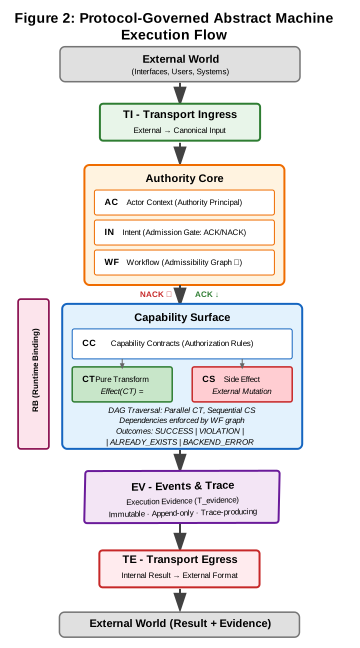
4. Execution Semantics: The Protocol-Governed Abstract Machine
The Machine Execution Space is realized by the Protocol-Governed Abstract Machine. The execution model operates as a Directed Acyclic Graph (DAG) traversal machine where each node represents a capability invocation and each edge represents a data or control dependency.
Node Types:
- Transform Nodes (CT_): Pure computation nodes with no side effects. Multiple transforms may execute in parallel if no data dependency exists.
- Side-Effect Nodes (CS_): Interact with external systems (databases, APIs, file systems). Execution order is determined by declared dependencies in the workflow.
- Control Nodes (Decision, Merge): Route execution based on outcomes (SUCCESS, VIOLATION, ALREADY_EXISTS, BACKEND_ERROR).
Execution Constraints:
- No out-of-order execution: Nodes execute only when all dependencies are satisfied.
- Deterministic routing: Control flow is determined by declared workflow structure, not runtime logic.
- Trace completeness: Every node execution emits a trace event with artifact identity, inputs, outputs, and outcome.
- Hermetic boundary: Execution occurs within a closed environment; all external interaction is mediated by CS_ nodes.
Admission Gate: Before any DAG traversal begins, the IN_ admission gate evaluates the execution request against declared authority and admission conditions [Ganti, 2026b, Section 3.4]. The gate produces exactly one of two outcomes:
- ACK: Execution request accepted; DAG traversal proceeds.
- NACK: Execution request rejected at admission gate; no traversal occurs.
This is the mechanism by which the runtime contracts the governance surface to a specific execution surface — it selects from what the snapshot already permits, never expanding what is admissible [Ganti, 2026b, Section 2.3].
Execution Outcomes: During DAG traversal, each capability step produces a declared outcome:
- SUCCESS: Admitted execution completed; capability produced expected result.
- VIOLATION: Admitted execution encountered a governed constraint violation during capability execution.
- ALREADY_EXISTS: Admitted execution detected an idempotency condition; no duplicate state produced.
- BACKEND_ERROR: Infrastructure or storage failure during capability execution; environmental, not constitutional.
The outcome vocabulary is organized into two categories: Admission outcomes (ACK, NACK) are produced by the IN_ gate before DAG traversal and are admissibility decisions. Execution outcomes (SUCCESS, VIOLATION, ALREADY_EXISTS, BACKEND_ERROR) are produced during DAG traversal by capability contracts and describe what happened during permitted execution [Ganti, 2026b, Section 5.2].
Each CC_ declares its allowed outcome surface — the set of outcomes it may produce. The runtime routes on these outcomes; it does not interpret them. Outcome semantics are protocol-defined; outcome routing is snapshot-defined.
Termination: Execution guarantees deterministic termination for well-formed graphs when all reachable terminal nodes have executed or when a governance event (EV_) signals halt. The execution engine guarantees eventual termination for well-formed workflows (acyclic graphs with bounded loops).
The abstract machine ensures that execution is a deterministic function of protocol + input + actor context, making behavior fully reproducible and auditable independent of implementation details.
5. Security Model and Threat Analysis
This section demonstrates that entire classes of vulnerabilities are architecturally unrepresentable in Protocol-Governed Systems. The proof follows from the structural properties established in Section 3 and the constitutional invariants defined in [Ganti, 2026b, Section 4].
5.1 Threat Model
We assume an adversary capable of:
- Supplying arbitrary external input
- Compromising execution implementations (CT_, CS_, RB_)
- Observing runtime state
- Attempting privilege escalation or behavioral injection
We do not assume compromise of governance artifacts or constitutional validation.
5.2 Elimination of Attack Classes
Remote Code Execution (RCE)
Definition: Execution of attacker-controlled logic not present in the system.
Claim: Execution of behavior not present in the admissibility graph is structurally impossible.
Justification: All execution paths originate from WF_ artifacts. No runtime code generation or dynamic evaluation occurs. Executed(b) ⇒ b ∈ V (bounded vocabulary). Input is treated as data, never as logic. Result: RCE ∉ G.
Invariant basis: S1 — Protocol Sovereignty; E4 — No Topology Synthesis; S2 — Compile-Time Resolution [Ganti, 2026b, Section 4.1–4.2].
Privilege Escalation
Definition: Gaining authority beyond intended permissions.
Claim: Privilege escalation is structurally unrepresentable within the admissibility graph.
Justification: Authority derives only from (AC_, IN_, WF_, CC_) declarations. No ambient authority exists. Unauthorized paths are absent from G. Result: Authority ⊆ Declared(G).
Invariant basis: S3 — No Ambient Authority [Ganti, 2026b, Section 4.1].
Injection Attacks (SQL Injection, Command Injection, XSS)
Definition: Transforming input into executable logic.
Claim: Injection attacks are structurally unrepresentable within the admissibility graph.
Justification: Strict separation between data and execution. All operations must be declared in WF. Execution graph is fixed at compile time. No amount of crafted input can introduce new operations. Result: Input ↛ Instruction.
Invariant basis: E4 — No Topology Synthesis; S2 — Compile-Time Resolution [Ganti, 2026b, Section 4.1–4.2].
Data Leakage
Definition: Unauthorized exposure of internal state.
Claim: Unauthorized protocol-level data exposure paths are structurally eliminated.
Justification: All outputs pass through TE (Transport Egress). Internal state is not directly accessible. Trace completeness ensures full observability. Result: Output = TE(σ).
Invariant basis: V1 — Trace Immutability; V2 — Trace Completeness [Ganti, 2026b, Section 4.3].
Execution Compromise
Definition: Malicious or faulty implementation behavior.
Claim: Execution compromise cannot expand behavioral reachability beyond the admissibility graph.
Justification: Security derives from protocol artifacts, not implementation. The machine controls execution transitions n → n’. Runtime binding (RB) is authority-neutral. RB resolves implementation references but cannot expand behavioral reachability beyond what is constructed in the admissibility graph. An implementation is architecturally sandwiched between its input schema and its output contract. It possesses neither the authority to reach outside its capability surface nor the ability to traverse unauthorized paths in G. Result: Compromise ⇒ Degradation, not escalation.
Invariant basis: S1 — Protocol Sovereignty; S6 — Runtime Non-Expansion [Ganti, 2026b, Section 4.1].
5.3 Attack Surface Quantification
In conventional systems, attack surface grows with codebase size, dynamic features, hidden dependencies, and interaction complexity. In Protocol-Governed Systems, Architecturally admissible attack surface equals:
|Attack Surface| = |CS_| + |AC_| + |RB_|
That is: mutation primitives (what can change state), authority artifacts (what authority exists), and binding declarations (what implementations are used). No other vector is structurally admissible. Attack surface is finite and enumerable.
An auditor need not analyze entire codebases, but only the enumerated side-effects (CS) and binding integrity (RB). This represents a drastic reduction in vulnerability search space.
5.4 Trace-Based Accountability
Every state mutation and computation step is attributable to a versioned artifact and actor:
∀step ∈ Execution: Attributable(step, artifact, actor)
Attribution is structural, not reconstructed. Every trace event records which artifact authorized the operation, which actor initiated the workflow, which capability was invoked, and what inputs and outputs occurred. Security is evidence-first:
Traditional Protocol-Governed Approach Approach
Detect anomalies Prove authorization
Investigate Replay execution incidents
Reconstruct Read trace evidence events
Trust log Verify trace against integrity artifacts
Traces provide forensic advantages: replay capability, semantic integrity verification, tamper detection via hash chains, and attribution certainty. Post-incident analysis shifts from “what might have happened” to “what exactly happened.”
6. Evaluation: Linear Scalability and the Governance Dividend
This section validates the scalability claims through theoretical analysis and empirical evidence from the OmniBachi reference implementation. The following claims are not empirical — they are structural consequences of the model defined in Sections 3 and 4.
6.1 The Complexity Problem in Conventional Systems
Software complexity scaling is the binding constraint. While throughput scaling is largely solved through horizontal scaling, caching, and distributed systems, complexity scaling remains unsolved. The question is: how do systems accommodate more features, more integrations, more edge cases, more configurations?
Conventional systems exhibit structural patterns that amplify complexity:
- Interwoven logic: Business logic and execution code are inseparable
- Implicit state mutation: State changes occur without explicit declaration
- Non-deterministic drift: Behavior changes through accumulated modifications
- Hidden control flow: Execution paths are not fully enumerable
As conventional systems grow, complexity exhibits non-linear growth. If N components can each potentially affect each other, interaction space is O(N²). Testing surface explodes as O(2^N) with N conditionals. Technical debt accumulates, and implicit semantic drift occurs — behavior changes without corresponding specification changes.
6.2 Structural Claim: Linear vs. Quadratic Governance Interaction Complexity
Protocol-Governed Systems exhibit:
Governance Interaction Complexity_PGS = O(N + M) vs. Governance Interaction Complexity_Traditional ≈ O(N × M)
where N is the number of distinct capabilities and M is the number of workflows composing those capabilities.
Traditional Complexity Growth: In conventional systems, each of N capabilities may need to integrate with each of M workflows through pairwise implementation dependencies — data flow, invocation patterns, error propagation, shared state. The interaction surface is O(N × M) because each capability-workflow pair requires its own integration code.
Protocol-Governed Complexity Growth: In PGS, capabilities declare their interfaces through CC_ contracts. Workflows compose capabilities through declared topology. Integration is not implemented in code — it is declared in protocol artifacts: orchestration order is declared in WF_ workflow DAG; data flow between capabilities is declared in CC_ machine block bindings; error routing is declared in WF_ outcome edges; cross-capability dependencies are structural, resolved at build time. The integration graph still exists — but it is a governance artifact, not code.
Scaling Differential:
System Size Traditional O(N PGS O(N + Ratio × M) M)
N=10, M=10 100 20 5×
N=50, M=50 2,500 100 25×
N=100, M=100 10,000 200 50×
N=1000, M=1000 1,000,000 2,000 500×
The differential increases with scale. Large protocol-governed systems are orders of magnitude less complex than equivalent conventional systems.
The scaling differential arises from how coupling manifests. Conventional systems: Coupling is emergent — components interact through implicit pathways that grow combinatorially. Protocol-governed systems: Coupling is explicit — components interact only through declared contracts. New components add their declared interactions, not combinatorial possibilities. Explicit coupling grows additively; emergent coupling grows multiplicatively.
6.3 Implementation Cost Topology
Define the total implementation cost of a traditional domain with N capabilities and M workflows:
C_trad(N,M) = C_logic(N) + C_integration(N,M) + C_state(N) + C_orchestration(M) + C_security(N,M)
The dominant cost term is integration: C_trad(N,M) ≈ C_integration(N,M) = O(N × M). This is the structural root of why traditional systems become expensive at scale: integration cost, not business complexity, drives the budget.
PGS partitions the same system into constitutionally isolated federation boundaries and implementation subsystems:
C_pgs(N,M) = C_protocol + C_executor + C_cs + C_ct(N)
Component Nature Growth
Protocol artifacts Declarative — no O(N + M) in artifact imperative code count, O(0) in SLOC
Execution engine Domain-blind, fixed O(1) — constant across all domains
Capability side effects Backend-aligned O(b) where b = backend adapters types (finite, small)
Capability transforms Domain-function C_reusable + C_novel(N) mechanics
Critical insight: Integration is not reduced — it is eliminated as imperative code and relocated to declarative protocol. In PGS, orchestration order is declared in WF_ workflow DAG; data flow between capabilities is declared in CC_ machine block bindings; error routing is declared in WF_ outcome edges; cross-capability dependencies are structural, resolved at build time. The integration graph still exists — but it is a governance artifact, not code. C_integration_pgs = 0 (in imperative SLOC).
Since C_executor, C_cs, and C_reusable are fixed or amortized:
C_pgs(N,M) ≈ K + C_novel(N)
where K is the fixed platform cost.
As the reusable capability substrate matures:
lim(domains→∞) C_novel(d) → 0
The marginal implementation cost of new domains approaches the cost of authoring governance artifacts alone.
6.4 Empirical Evidence: OmniBachi
The OmniBachi reference implementation validates these properties through concrete measurements:
Structural Change Locality: A system-wide identity model update required 5 localized changes, 1 STRUCTURE artifact, and 0 execution-layer modifications. This demonstrates bounded change propagation even for cross-cutting concerns.
Domain Cost: A greenfield domain (AI Agent Governance) required zero execution engine changes, zero novel capability transforms (full reuse of existing CT_ capabilities), and only protocol artifacts (WF_, CC_, IN_). Implementation consisted entirely of declarative authoring, validating the claim that C_novel(d) → 0 as the reusable capabilities matures.
Determinism: Identical inputs produce identical traces. Traces fully reconstruct behavior. This validates the evidence-backed execution model.
Attack Surface Reduction: |Surface| = |CS_| + |AC_| + |RB_|. For OmniBachi, |CS_| = 6, |AC_| = 7, |RB_| = 7, yielding a total attack surface of 20 artifacts across the entire platform — orders of magnitude smaller than conventional architectures of comparable functionality.
6.5 The Governance Dividend
The Governance Dividend is the long-term reduction in behavioral ambiguity, mutation surface sprawl, change propagation cost, testing uncertainty, and conformance ambiguity achieved through constitutional constraint.
Conventional systems accumulate technical debt: quick fixes create areas requiring more quick fixes, creating debt accumulation spirals. Commonly reported estimates suggest technical debt eventually consumes 40-60% of development capacity in large conventional systems.
Protocol governance inverts the debt accumulation curve by enforcing version immutability (changes create versions, not overwrites), explicit amendment (all changes are declared and governed), referential integrity (references resolve; no dangling dependencies), and trace-based validation (behavior is verifiable against specification).
This shifts cost distribution:
Conventional: Low G_0, High growing ΔC Protocol-Governed: Higher G_0, Lower stable ΔC
where G_0 = initial governance/design cost and ΔC = per-change cost.
Conventional trajectory: Low initial investment, debt accumulates, per-change cost grows, eventually change becomes prohibitively expensive.
Protocol-governed trajectory: Higher initial investment, debt does not accumulate (explicit versioning), per-change cost remains stable, change remains tractable indefinitely.
The crossover point depends on system lifespan and change frequency. For non-trivial systems with multi-year lifespans, crossover typically occurs within the first major evolution cycle.
6.6 Scaling Law
Total Cost = K + C(d) with ΔC(d) ↓ over time. As systems grow, marginal cost decreases and complexity remains bounded. PGS scalability is a structural consequence of its design.
7. Conclusion
The rapid acceleration of AI-assisted software generation exposes a fundamental architectural limitation: behavior is implicitly defined by implementation, while governance operates reactively and cannot match generation velocity. This generation-governance impedance mismatch (V_g >> V_gov) cannot be resolved through process scaling alone.
Protocol-Governed Systems resolve this mismatch structurally by:
Separating behavioral authority from implementation mechanics: Behavior is defined in versioned protocol artifacts, not derived from code.
Enforcing governance at compile time: The Compiler Layer constructs deterministic execution graphs from protocol declarations, determining behavioral admissibility without executing implementation code.
Eliminating ambient authority: Code possesses no inherent authority; all privileges originate from explicit protocol declarations.
Providing trace-based evidence: Every execution produces an immutable, deterministic trace that proves conformance to protocol law.
Scaling governance linearly: Complexity grows as O(N + M) rather than O(N × M) through protocol-mediated capability interfaces.
The architecture achieves closure under AI authorship conditions: behavioral authority is preserved under arbitrary implementation generation velocity. No new architectural primitives are required. The separation of behavioral authority from implementation mechanics — established throughout this work and grounded in the conceptual model [Ganti, 2026b] — is sufficient to govern AI-generated systems.
As AI-generated code becomes the majority of production software, the question that defines software governance shifts from “Did a human review this code?” to “Is this behavior authorized by institutional law, and can you prove it?” Protocol-Governed Systems provide both the authorization mechanism and the proof.
In PGS, protocol defines admissible behavior while implementation fulfills admissible capability contracts. This distinction is foundational: protocol governs what may exist; implementation provides how it is realized.
PGS transforms software engineering from a discipline of reactive mitigation into a science of proactive construction. Behavior is no longer an emergent property of code — it is a constructed property of protocol.
PGS establishes behavioral admissibility as a compile-time property, transforming execution from an act of interpretation into an act of construction — the track laid by governance, traversed deterministically by the runtime.
Appendix A: Reference Implementation (OmniBachi)
A.1. Purpose
The OmniBachi reference implementation validates the feasibility of the PGS model, serving as a proof-of-structure demonstrating that theoretical constructs can be realized without compromise. The implementation further validates that behavioral admissibility can be constructed independently of implementation semantics while preserving deterministic execution, bounded authority, implementation-independent runtime behavior, and governance scalability.
A.2. Repositories
It is organized as an eight-repository ecosystem, each with a distinct architectural role:
Repository Role
pgs_workspace Public operational entry point containing compiled protocol snapshot, execution tooling, traces, and demonstration workflows
pgs_runtime Deterministic semantic-agnostic execution engine (omnibachi) responsible for admissibility graph traversal
pgs_governance Constitutional governance source-of-truth: federated boundaries, structural artifact definitions, invariant enforcement, and assertion handlers
pgs_compiler Compiler pipeline and protocol tooling: artifact discovery, validation, admissibility construction, conformance generation, and snapshot build
pgs_transport Transport realization boundary: ingress and egress adapters for HTTP and CLI surfaces
pgs_capabilities Shared governed capability substrate containing reusable CT and CS implementations and capability protocol artifacts
pgs_blockchain Federated blockchain governance domain implementing identity, wallet, and transaction protocols
pgs_ai_governance Federated AI governance domain implementing agent governance, licensing, reclamation, and policy workflows
All repositories are publicly available under the GitHub organization protocol-governed-computing. The earlier implementation this paper was written against remains under bachipeachy, frozen and kept for lineage.
The implementation directly realizes the four-layer architecture and the Dual-Space operational model described in Section 3. Human Governance Space responsibilities are represented through protocol authoring, federation-boundary governance, constitutional validation, and admissibility construction, while the Machine Execution Space realizes deterministic execution solely through compiled admissibility topology.
A.3 Implementation Overview
OmniBachi is composed of distinct functional layers:
Functional Layer Responsibility
Tooling Developer tooling: compiler-phase artifact validation, trace examination, visualization, and structure resolution
Governance Constitutional validation, federation-boundary governance, invariant enforcement
Structure Canonical identity, discovery, namespace governance, and deterministic resolution
Compiler Validation, admissibility construction, dependency resolution, topology materialization, and conformance verification
Execution Deterministic admissibility-graph traversal
Capability Substrate Governed CT and CS implementations resolved through RB
Federated Domains Domain-specific governance vocabularies and workflows
Execution is domain-agnostic and invariant across domains. Runtime Bindings (RB_) resolve both CT_ and CS_ to their concrete implementations, making the runtime fully implementation-agnostic across all capability types.
The runtime performs deterministic admissibility-graph traversal without semantic interpretation of workflow meaning, protocol intent, or implementation logic. Behavioral admissibility is fully determined prior to runtime through compilation.
A.4 Model Coverage
Fully Implemented:
- Admissibility graph construction
- Deterministic execution engine
- Execution trace generation
- Construction-time admissibility evidence generation
- Deterministic topology materialization
- Compile-time dependency closure
- Protocol-snapshot execution isolation
- Security inversion principles
- Closed-loop boundary enforcement
- Symmetric CT/CS runtime binding
- FQDN-only canonical identity resolution
Partially Implemented:
- Full invariant verification framework
- Event-driven reactive governance
- Multi-domain ecosystem validation
- Federated execution topology governance
- Cryptographic trust federation
Open Work:
- Formal proofs of correctness
- Distributed execution
- Cryptographic trace attestation
- Silicon-hosted execution
- Hardware-assisted deterministic execution
A.5 Empirical Observations
Structural Change Locality: A system-wide identity model update required five localized implementation changes, one STRUCTURE artifact, and zero execution-engine modifications. This demonstrates bounded change propagation and validates the Governance Dividend described in Section 6.
Domain Cost: A greenfield domain (AI Agent Governance) required zero execution engine changes, zero novel capability transforms (full reuse of existing CT_ capabilities), and only protocol artifacts (WF_, CC_, IN_). Implementation consisted almost entirely of declarative authoring, validating the claim that marginal domain construction cost decreases as the governed capability substrate matures.
Determinism: Identical inputs produce identical traces. Traces fully reconstruct behavior. This validates the evidence-backed execution model.
Evidence Generation: OmniBachi produces both construction-time admissibility evidence and execution-time realization evidence. Compilation records admissibility determination, dependency closure, topology construction, and protocol conformance, while runtime execution records exact traversal paths, authority context, side-effects, and execution outcomes.
Attack Surface Reduction:
|Attack Surface| = |CS_| + |AC_| + |RB_|
For OmniBachi:
|Attack Surface| = 6 + 7 + 7 = 20
yielding a finite, enumerable, and structurally isolated attack surface across the platform.
A.6 Constraints
- FQDN-only identity
- No runtime discovery
- No implicit behavior
- No heuristic resolution
- No semantic runtime inference
- No cross-layer leakage
Canonical Identity Constraint: All protocol artifacts employ fully qualified deterministic identities (FQDN-only identity). No short-name resolution, heuristic lookup, runtime discovery, or implicit namespace inference is permitted anywhere within the execution model.
A.7 Limitations
- Single-node execution focus
- Limited performance optimization
- Evolving tooling and ergonomics
- Partial federation-boundary coverage
A.8 Reproducibility
Clone pgs_workspace from:
https://github.com/protocol-governed-computing
and follow the bootstrap instructions. The workspace bootstrap process installs all sibling repositories as editable packages and wires the runtime to the compiled admissibility graph.
Full compilation, execution, trace generation, evidence-backed replay, and domain extension are demonstrated in scripts/demo_sample_workflow.sh.
A.9 Interpretation
The implementation demonstrates that PGS is practically realizable, that its core properties are structural rather than theoretical, and that admissibility construction, deterministic execution, bounded authority, implementation-independent enforcement, and evidence-backed execution emerge from the architecture itself rather than from post-hoc enforcement mechanisms layered onto implementation code.
The implementation further validates that governance-defined behavioral admissibility can remain stable even as implementations evolve, are regenerated, or are replaced entirely. Behavioral authority therefore persists independently of implementation identity, establishing governance as a first-class computational construct rather than an external operational concern.
Appendix B: Essential Vocabulary
Purpose
This appendix defines the operational vocabulary of Protocol-Governed Systems. PGS vocabulary is operational, not descriptive. Each term corresponds to a structural role within the system. Definitions are aligned with the authoritative conceptual model [Ganti, 2026b].
The Core Paradigm
Protocol-Governed System (PGS)
A computational model where behavior is a compiled artifact of protocol declarations, rather than an emergent property of implementation code. PGS is a constitutional execution substrate — the governed artifact grammar and deterministic execution semantics within which any PGS-conformant execution protocol is defined, compiled, and executed [Ganti, 2026b, Section 1.3].
Protocol Artifact
A declarative unit of behavior (Intent, Workflow, Capability Contract) that is validated prior to runtime and transformed into an execution graph.
Admissibility Graph (G)
The deterministic set of all authorized execution paths. G = (V, E). If a path is not in G, it is unreachable and unrepresentable.
Execution Trace (T_evidence)
The authoritative execution record of the system: an immutable, causally ordered record of execution. Captures node transitions, inputs and outputs, and side-effects. The trace proves that execution followed an admissible path.
Protocol Snapshot
The compiled, verified, read-only artifact bundle that a runtime ingests. It is the immutable admissibility boundary between governance and execution. The snapshot contains all information a generic runtime needs to execute any declared workflow — and nothing more [Ganti, 2026b, Section 2.1].
Federation Boundary (fb.)*
A semantic sovereignty region representing bounded protocol authority, ownership scope, publication scope, compilation containment, and governance isolation [Ganti, 2026b, Section 2.5].
Sovereign Boundary
The unique federation boundary (fb.constitution) that originates foundational protocol legality and constitutional authority.
Delegated Boundary
A federation boundary deriving governance legitimacy from the sovereign constitutional boundary while maintaining isolated semantic ownership.
Publication Scope
The compile-time visibility and aggregation legality of protocol artifacts across federation boundaries. Publication scope governs discoverability and compilation participation, not runtime communication.
Architecture and Computational Substrate
For the four-layer architecture, see Section 3.1. For the nine execution concerns and their groupings, see Section 3.2 (Machine Execution Space). For Runtime Binding (RB_), see Section 3.2 (Orthogonal Resolution).
Structural Guarantees (Summary)
Guarantee Definition
Implementation-independent Runtime enforces topology without enforcement interpreting implementation logic
Security Inversion Unauthorized topology is structurally unconstructible, not detected post-hoc
Implementation Blindness Implementations cannot access each other or alter execution structure
Structural Purity Effect(CT) = ∅ is a constitutional invariant, not a convention [Ganti, 2026b, E2]
Enumerated Mutation All state changes occur through declared CS_ artifacts; mutation surface is finite
Closed-Loop Execution All interaction follows TI_ → G → TE_; no other path is admissible
Referential Persistence Governance-defined admissibility persists independently of implementation identity
Governance Dividend Per-change cost stabilizes as the system grows (Section 6.5)
Admissibility Model
Admissibility in PGS is compositional, operating at four layers with distinct timing and semantics [Ganti, 2026b, Section 3]:
Layer 1 — Constitutional Admissibility (compile time): Does this protocol definition satisfy all constitutional invariants?
Layer 2 — Structural Admissibility (compile time, verified on load): Are all artifacts referenced in this workflow DAG resolved within the snapshot?
Layer 3 — Authority Admissibility (runtime, at TI_/IN_ boundary): Does this specific execution request satisfy declared authority and admission conditions? Produces ACK or NACK.
Layer 4 — Topological Admissibility (runtime, per capability step): Are this step’s declared input requirements satisfiable from the current execution context? Guaranteed by structural admissibility (Layer 2).
Outcome Vocabulary
Admission Outcomes (produced by IN_ gate, before DAG traversal):
- ACK: Execution request accepted; DAG traversal proceeds.
- NACK: Execution request rejected; no traversal occurs.
Execution Outcomes (produced during DAG traversal by capability contracts):
- SUCCESS: Capability completed; expected result produced.
- VIOLATION: Governed constraint violation during capability execution.
- ALREADY_EXISTS: Idempotency condition detected; no duplicate state produced.
- BACKEND_ERROR: Infrastructure or storage failure; environmental, not constitutional.
Appendix C: References
Foundational Reference
Bachi aka Bhash Ganti (2026b). Protocol-Governed Systems: A Conceptual Model. Zenodo. DOI: https://doi.org/10.5281/zenodo.20300611
Working Paper Series
Note: All referenced PGS working papers are authored by the same author and serve as supporting materials for the development of the model presented below. These working papers provided foundational insights and were refined based on early review comments, culminating in the consolidated model presented herein.
Bachi aka Bhash Ganti (2026a). Protocol-Governed Systems: An architectural foundation for the AI era. Zenodo Working Paper. DOI: https://doi.org/10.5281/zenodo.18715516
Bhash Ganti (2026b). Protocol-Governed Systems: A Conceptual Model.
Zenodo Preprint.
https://doi.org/10.5281/zenodo.20300611
Bachi aka Bhash Ganti (2026c). Protocol-Governed Systems: A constitutional realization of Turing-complete systems. Zenodo Working Paper. DOI: https://doi.org/10.5281/zenodo.18718409
Bachi aka Bhash Ganti (2026d). The Federation-Concern Constitutional Model: A formal structural taxonomy for protocol-governed systems. Zenodo Working Paper. DOI: https://doi.org/10.5281/zenodo.18719589
Bachi aka Bhash Ganti (2026e). Governance and Authoring: The legislative process of behavioral law. Zenodo Working Paper. DOI: https://doi.org/10.5281/zenodo.18929868
Bachi aka Bhash Ganti (2026f). Protocol as Law: Behavioral specification and versioned authority. Zenodo Working Paper. DOI: https://doi.org/10.5281/zenodo.18930048
Bachi aka Bhash Ganti (2026g). Deterministic Enforcement: Runtime binding, execution, and trace conformance. Zenodo Working Paper. DOI: https://doi.org/10.5281/zenodo.18930314
Bachi aka Bhash Ganti (2026h). Pure Computation and Governed Mutation: Capability transforms and side effects in protocol-governed systems. Zenodo Working Paper. DOI: https://doi.org/10.5281/zenodo.18930423
Bachi aka Bhash Ganti (2026i). The Inversion of Trust: Vocabulary-bounded security in protocol-governed systems. Zenodo Working Paper. DOI: https://doi.org/10.5281/zenodo.18930512
Bachi aka Bhash Ganti (2026j). The Three Dividends: Governance, Protocol, and Architecture Economics in Protocol-Governed Systems. Zenodo Working Paper. DOI: https://doi.org/10.5281/zenodo.18930787
Foundational Works
Church, A. (1941). The calculi of lambda-conversion. Annals of Mathematics Studies, 6.
Dijkstra, E.W. (1974). On the role of scientific thought. EWD447.
Dijkstra, E.W. (1982). On the role of scientific thought. In Selected Writings on Computing: A Personal Perspective, pages 60–66. Springer.
Hoare, C.A.R. (1969). An axiomatic basis for computer programming. Communications of the ACM, 12(10):576–580.
Programming Languages and Type Systems
Hughes, J. (1989). Why functional programming matters. The Computer Journal, 32(2):98–107.
Moggi, E. (1991). Notions of computation and monads. Information and Computation, 93(1):55–92.
Peyton Jones, S. (2001). Tackling the awkward squad: monadic input/output, concurrency, exceptions, and foreign-language calls in Haskell. In Engineering Theories of Software Construction, pages 47–96. IOS Press.
Wadler, P. (1995). Monads for functional programming. In Advanced Functional Programming, pages 24–52. Springer.
Formal Methods and Specification
Clarke, E.M., Henzinger, T.A., Veith, H., and Bloem, R. (2018). Handbook of Model Checking. Springer.
Lamport, L. (1978). Time, clocks, and the ordering of events in a distributed system. Communications of the ACM, 21(7):558–565.
Lamport, L. (2002). Specifying Systems: The TLA+ Language and Tools for Hardware and Software Engineers. Addison-Wesley.
Milner, R. (1999). Communicating and Mobile Systems: The Pi-Calculus. Cambridge University Press.
Spivey, J.M. (1989). The Z Notation: A Reference Manual. Prentice Hall.
Dataflow and Process Models
Kahn, G. (1974). The semantics of a simple language for parallel programming. In Information Processing 74: Proceedings of IFIP Congress, pages 471–475. North-Holland.
Hewitt, C., Bishop, P., and Steiger, R. (1973). A universal modular actor formalism for artificial intelligence. In Proceedings of the 3rd International Joint Conference on Artificial Intelligence, pages 235–245.
Petri, C.A. (1962). Kommunikation mit Automaten. Schriften des Institutes für Instrumentelle Mathematik, Universität Bonn.
Software Architecture and Design
Buschmann, F., Meunier, R., Rohnert, H., Sommerlad, P., and Stal, M. (1996). Pattern-Oriented Software Architecture: A System of Patterns. Wiley.
Kiczales, G., Lamping, J., Mendhekar, A., Maeda, C., Lopes, C., Loingtier, J.-M., and Irwin, J. (1997). Aspect-oriented programming. In European Conference on Object-Oriented Programming, pages 220–242. Springer.
Meyer, B. (1988). Object-Oriented Software Construction. Prentice Hall.
Object Management Group (2011). Business process model and notation (BPMN) version 2.0. OMG Standard.
Object Management Group (2014). Model driven architecture (MDA) guide revision 2.0. OMG Document ormsc/14-06-01.
Parnas, D.L. (1972). On the criteria to be used in decomposing systems into modules. Communications of the ACM, 15(12):1053–1058.
van der Aalst, W.M.P., ter Hofstede, A.H.M., Kiepuszewski, B., and Barros, A.P. (2003). Workflow patterns. Distributed and Parallel Databases, 14(1):5–51.
Security
Saltzer, J.H., and Schroeder, M.D. (1975). The protection of information in computer systems. Proceedings of the IEEE, 63(9):1278–1308.
AI and Code Generation
Amodei, D., Olah, C., Steinhardt, J., Christiano, P., Schulman, J., and Mane, D. (2016). Concrete problems in AI safety. arXiv preprint arXiv:1606.06565.
Chen, M., Tworek, J., Jun, H., et al. (2021). Evaluating large language models trained on code. arXiv preprint arXiv:2107.03374.
Pearce, H., Ahmad, B., Tan, B., Dolan-Gavitt, B., and Karri, R. (2022). Asleep at the keyboard? Assessing the security of GitHub Copilot’s code contributions. IEEE Symposium on Security and Privacy, pages 754–768.
Russell, S. (2019). Human Compatible: Artificial Intelligence and the Problem of Control. Viking.
Institutional Economics
North, D.C. (1990). Institutions, Institutional Change and Economic Performance. Cambridge University Press.
Author Information
Bhash Ganti aka Bachi
Contact: bachipeachy@gmail.com