Author: Bhash Ganti (aka Bachi)
(c) 2026 Bhash Ganti. All rights reserved. Released under the Apache-2.0 License.
bachipeachy@gmail.com · ORCID 0009-0007-3810-6520
Preprint: https://doi.org/10.5281/zenodo.22736531 — this page is the frozen rendition of that deposit.
Abstract
Conventional software architecture spreads behavioral authority across several sources. Declarations govern some behavior. Implementation, build tooling and runtime decide the rest. Protocol-Governed Computing reverses that arrangement. Governed declarations determine authorized behavior, business process rules included. Construction, implementation and execution realize that determination and add nothing to it.
This paper derives the reversal rather than proposing it. Five properties serve as premises, each established in prior work: declarations determine authorized behavior before execution; sealed state carries authority; construction admits or refuses but never repairs; change derives a named successor from a named predecessor; and obligations stay inspectable, refusable and evidenced whoever performs the activity. Conventional architecture assumes the contrary in each case, and the contradictions force reversal.
Two results follow that the paper never assumes. Execution preserves authority rather than creating it. Workers stay independent of authority, so a human, an AI system or a hybrid may perform governed activity without acquiring it. The same derivation runs through governance, orchestration, engineering and scale, and the paper catalogues what it buys: an enumerable governed behavioral surface, implementation-free business rules, and machine-speed generation without wider authority.
The scale domain yields the Governance Dividend, a structural scaling claim stated with an evaluation design rather than measured results. Declared dependencies, not incidental ones, bound an artifact’s governed change surface. Adding an artifact need not enlarge the change surface of artifacts that do not depend on it. The claim is conditional and names what falsifies it: unstable governance accumulates coordination debt through the same mechanism.
Keywords: software architecture; architectural style; behavioral authority; declarative execution; governed construction; software evolution; protocol-governed computing
1. Introduction
Software behavior rarely comes from one place. Requirements, policies, workflow descriptions and configuration state part of it. Implementation code determines another part directly. Build tooling, deployment conventions, runtime defaults and recovery paths supply the rest. Each source is legitimate in conventional practice. Together they leave a system in which no single artifact determines everything the system may do.
Protocol-Governed Computing (PGC) reverses that arrangement. Governed declarations determine authorized behavior. Construction, implementation and execution become mechanisms that realize the determination. They stop being sources of it. The lifecycle paper argues this baseline at length [3]; this paper states it compactly and moves on.
The reversal is not offered here as a design preference. This paper derives it. Five properties of PGC serve as premises. Prior work establishes each one. Conventional architecture assumes the contrary in each case. Hold both and a contradiction appears, and only the reversal resolves it.
The contribution is the joint implication. Taken singly, each property is already published. Taken together, they contradict foundational assumptions of conventional architecture across four domains, and the contradictions resolve in one direction. That is the argument, and it closes.
An earlier deposit introduced the inversion as a set of architectural observations [4], building on a conceptual model of the same family [6]. This paper supersedes that treatment. It does not extend it. The observations are re-derived here from stated premises, several collapse into one derivation, and the reader needs no prior paper in the series to follow the argument.
Two results deserve early notice because the paper derives them rather than assuming them. First, execution preserves authority. A runtime that answers an omitted question would originate behavior that no declaration authorized. Second, workers stay independent of authority. Changing who performs a governed activity does not change what the resulting system may do. Both follow from the premises in Section 5.
Section 2 gives the minimum architecture the derivation needs. Section 3 stipulates the five properties and cites their grounding. Section 4 states the conventional baseline. Section 5 defines the derivation rule and works the two results. Sections 6 through 9 derive consequences across the four domains. Section 10 states the Governance Dividend as a scaling claim and gives the design that would settle it. Section 11 states what the inversion makes possible. Section 12 separates derivation from evidence. Section 13 positions PGC against neighboring work. Section 14 concludes.
2. Protocol-Governed Computing in brief
2.1 What “governance” names here
Software engineering usually reads “governance” as oversight of engineering work. Review boards, approval gates, access control, audit trails and release sign-off all fit that reading. This paper does not mean that.
In PGC, governed declarations carry the behavior itself. They state the business process rules, the workflows, the domain constraints and the capability contracts [3, 6]. They determine what the system does, not merely what people may do to the system. Compliance governance is a small subset of this, not the whole of it.
The distinction matters for reading everything that follows. When this paper says governance determines authorized behavior, it means the business rules live in governed declarations. It does not mean a policy layer wraps an otherwise conventional application.
One further clarification prevents a common misreading. Implementation still computes. Capability implementations run algorithms, transform data, call services and hold control logic. What implementation cannot do is independently determine authorized behavior. The claim concerns the location of authority, not the absence of computation in code. Without this distinction, a reader may reasonably conclude that PGC merely relocates business logic into a declaration format.
2.2 The functional sequence
PGC composes four functions.
- Governed declarations determine authorized behavior. They hold protocols, rules, profiles, constraints, workflows and domain declarations. They fix what may happen before execution begins.
- Transformation derives the next declarations [2]. It starts from a named predecessor and a stated purpose, then proceeds through staged derivation. It never starts from a blank space. The current baseline supplies evidence, reusable structure and the boundary against which the transformation checks its claims.
- Governed construction [3] compiles declarations into verified projections, assembles them under a manifest and seals the result as an immutable snapshot. It admits or refuses. It never repairs. A generator may materialize a declared design; it may not turn an omission into a decision.
- Execution realizes the sealed snapshot [1]. The runtime verifies integrity, then traverses the structure the snapshot contains. The snapshot binds capabilities; the runtime does not discover them. Declared data carries routing; runtime logic does not compute it. Where the snapshot is silent, execution refuses.
One constraint spans the fourth function. The runtime emits traces as evidence, and those traces never become a hidden input to later behavior. An evidence channel that fed back into execution would reintroduce an ungoverned source of decisions.
Figure 1 shows the functional architecture. Each property appears where it arises rather than in a separate list. The two shaded results are derived in Section 5, not assumed.
Figure 1. Functional architecture of Protocol-Governed Computing.
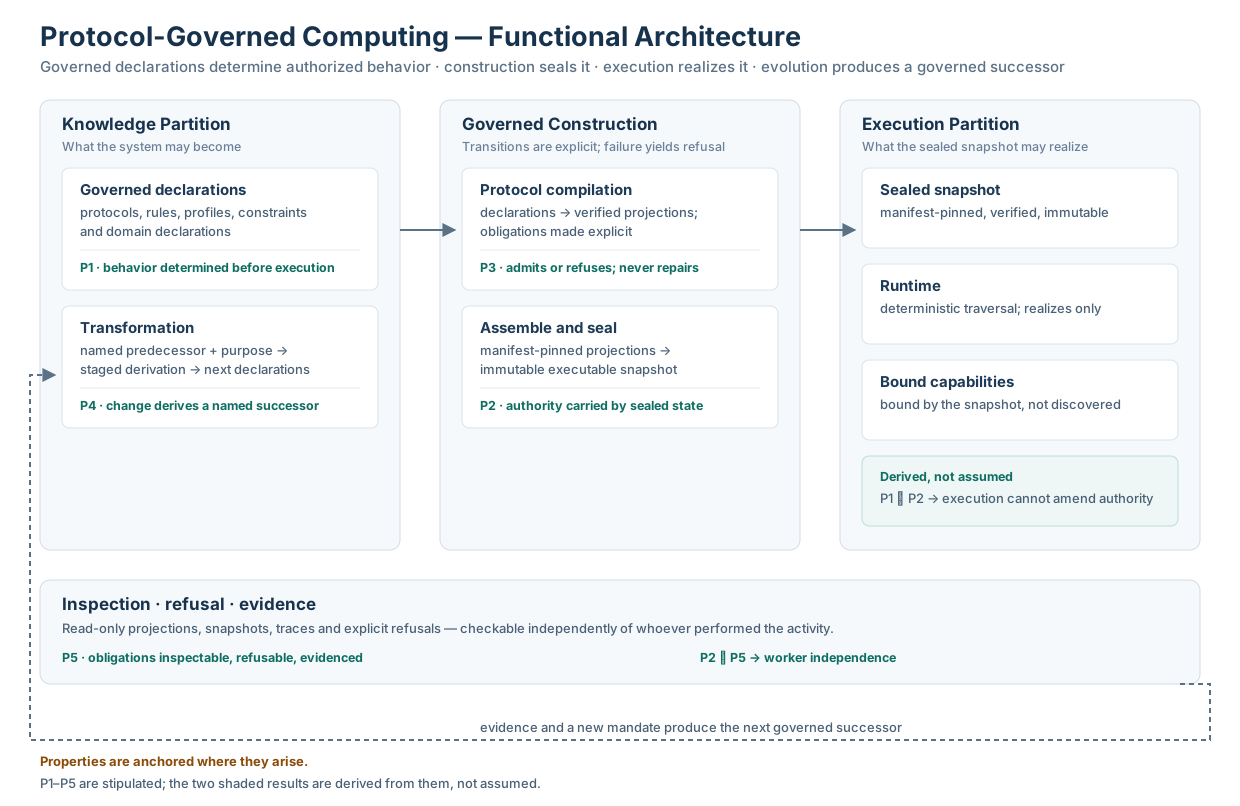
Repository names, command names, languages and deployment substrates may all vary. The functional boundaries are what this paper argues about.
3. Architectural properties
Five properties carry the derivation. This paper does not establish them. It stipulates them as the architecture’s design commitments and cites where prior work establishes each one.
None of the five is novel in isolation. Determinism before execution, content-identified immutable build products, and authority bounded by what an actor is given are long-established ideas, developed in reproducible builds [11], capability security [13, 14] and declarative deployment [9, 10]. What the PGC series contributes is the particular formulation used here, and what this paper contributes is the consequence of adopting all five together.
P1. Declarative determination
Governed declarations determine authorized behavior before execution. A compiled protocol is complete with respect to the behavior it permits. It never requires a runtime to infer a branch, fill a default, discover a handler or construct a missing graph. An Architecture for Deterministic Declarative Execution establishes this property [1].
Two terms stay distinct throughout this paper. Authorized names where behavioral authority resides. Admissible names what construction decides about a candidate declaration. The paper never interchanges them.
P1 does not forbid response to changing input or state. Different initial states may select different declared paths. What P1 forbids is a runtime inventing an undeclared path.
P2. Authorization carried by state
Construction establishes authority, and the sealed result carries it. The snapshot is not a cache or a build by-product. It is the content-identified, immutable state that execution is authorized to realize. The runtime never reconstructs that authority from its environment. Reference [1] grounds P2, and [3] makes it operational.
In this paper, behavioral authority means authority to select or introduce a system behavior. It is not identity, access-control privilege, confidentiality, integrity or resistance to compromise. A worker may hold operational credentials while holding no behavioral authority, and an admitted capability may still contain security defects.
An authored baseline differs from a sealed snapshot. Transformation produces the baseline. Compilation seals it into the object that execution addresses. The snapshot is the boundary between governed construction and execution.
P3. Governed construction
Construction determines admissibility and refuses. It never repairs, completes or supplies authority. A design must determine the artifacts it schedules. A missing field, an unresolved question, an unrecognized rule mechanism or an underdetermined artifact each triggers refusal. Reference [3] grounds this property.
A build that succeeds by supplying omitted semantics has created a second producer of meaning beneath the governing process. That is the failure P3 excludes.
P4. Successor evolution
Change derives a named successor from a named predecessor. It does not mutate an uncontrolled baseline. The current baseline participates in its own transformation in three ways: it supplies reusable structure, it bounds admissibility, and it anchors claims about what already exists. References [2] and [3] ground this property.
Transformation is relative to a pinned predecessor. It may produce a candidate, and promotion may make that candidate the successor. Until promotion, the running system is unchanged. Amending an existing artifact requires whole redeclaration, because an implicit merge with current state would make the output depend on material the design never determined.
P5. Checkable governance
Governing obligations stay inspectable, refusable and evidenced, independently of whoever performs the activity. Rules are declared as data with named evaluation mechanisms. An unknown mechanism fails rather than being skipped. A refusal names the governing rule and its location. Execution emits evidence of path and effect. The composition answers questions about its own governed structure. Reference [3] grounds this property.
P5 asks more than reviewability. A system must apply the obligation. Exposing a document that a person could inspect does not satisfy it.
Minimality
None of the five derives from the others. P1 does not imply that authority persists in state. P2 does not imply refusal over repair. P3 does not imply named successor evolution. P4 does not imply independently checkable obligations. P5 does not imply that declarations fix behavior before execution.
Two properties that readers often expect are deliberately absent. Execution authority-preservation and worker independence are results. Section 5 derives them.
4. The conventional baseline
An inversion needs something to invert. The baseline below is not a caricature. It states assumptions that mainstream architecture and engineering practice commonly hold, at the level the derivation needs.
A1. Behavioral authority is legitimately distributed. Explicit governance artifacts carry some of it. Implementation carries the rest. Neither is required to be the sole authoritative source. This assumption governs the other four.
A2. Runtime may resolve what construction left open. A runtime may select a handler, plan a route, infer a missing relation, retry an operation, apply a default or enter a degraded mode. These behaviors are often useful. Their authority is created at execution time.
A3. Build and deployment mechanisms may supply defaults. Configuration, code generation, dependency resolution, reconciliation and deployment controllers routinely complete an artifact from information spread across design, environment and current state. The governing declaration alone need not determine final behavior.
A4. Change is modification of an existing artifact. A developer edits a file, applies a patch, merges a branch or reconciles desired state against current state. The existing artifact is a starting point. It is not necessarily a named participant whose identity, evidence and admissibility boundary belong to the transformation.
A5. Governance is supervisory and external. Reviews, approvals, policies and audits examine engineering activity or its outputs. They may block a release. The executable system itself need not carry or enforce the governing obligation.
A6. Coordination cost grows with system size. Components acquire dependencies. Changes cross boundaries. The number of parties who must understand or approve a change grows with the number of artifacts and relationships. Modularity slows this growth. It does not establish that adding a component leaves existing change surfaces untouched.
These are not universal laws. They are the conventional poles against which the PGC properties stand, and they set the direction of each reversal.
5. The inversion imperative
The derivation rule is short.
A PGC property, together with a conventional assumption that contradicts it, forces that assumption to reverse.
The results that follow are conditional propositions over the PGC model. They state what follows if P1 through P5 hold. They do not establish that an implementation satisfies those properties, nor that the properties are preferable to a conventional arrangement. Whether an implementation satisfies them is a separate question, addressed only for the reference realization in Section 12.2.
“Forces” is structural. Retain the conventional assumption and the property is either violated or rendered inert. The reversal is not a preference chosen from a menu. It is the arrangement that preserves the premise.
5.1 Execution preserves authority
Take P1 (declarative determination) with P2 (authorization carried by state). P1 fixes authorized behavior before execution. P2 puts that authority in sealed state.
Now suppose execution meets an omitted behavioral decision, and the runtime answers it. That answer was never determined before execution, which violates P1 (declarative determination). The snapshot does not carry it, which violates P2 (authorization carried by state). Within this architecture, the answer holds no authority at all.
Execution must therefore preserve authority. The runtime realizes a decision the snapshot carries. Or it refuses where the snapshot is silent. It cannot infer, default, plan, discover or repair its way past the omission. Reference [1] develops this closure for the execution partition in detail.
This result says more than “keep the runtime thin.” A thin runtime may still hold an implicit fallback or a dynamic dispatch rule that adds behavior. The result concerns authority, not size. A large runtime preserves authority as long as sealed state selects everything it does. A small runtime violates the result the moment it creates one undeclared branch.
The result also sharpens what determinism means here. Give the runtime the same sealed protocol, the same inputs and the same initial state, and it produces the same declared behavior and the same trace. A different state may select a different path, but the protocol still selects it. Determinism is not the claim that every invocation ends the same way. It is the claim that the runtime adds no choice of its own, under the declared execution model: a fixed evaluation order, controlled clocks and randomness, and a declared failure model.
The closure claim ranges over behavior represented in the declared capability and orchestration model. It does not claim that the architecture determines physical timing, availability, third-party behavior or every implementation-level failure mode.
5.2 Workers stay independent of authority
Take P2 (authorization carried by state) with P5 (checkable governance). P2 locates authority in governed state. P5 makes obligations and evidence checkable without reference to the actor. Now consider two workers performing the same governed activity — a human engineer, an automated model, or the two working together.
Suppose changing the worker changed what the system was authorized to do. Then authority would reside partly in the worker, and P2 (authorization carried by state) fails. Suppose instead that changing the worker changed whether an obligation applied. Then the obligation was not independently checkable, and P5 (checkable governance) fails.
Worker independence follows. A worker may exercise judgment where the architecture assigns judgment. A worker may produce a proposal and carry out a governed stage. A worker does not thereby authorize an artifact, widen its scope or alter the authority of sealed state. Workers are substitutable with respect to authorization, because the governing machinery admits, seals and evidences the output rather than trusting it on the strength of its author.
This is not a claim that all workers are equally capable or equally reliable. It is a claim that the guarantees do not rest on the worker’s identity.
The point matters for AI-assisted engineering. An AI system can be a worker without becoming an architectural authority. Its proposals face the same staged derivation, admission, validation and promotion that a person’s proposals face. The independence is mechanical, not rhetorical. A companion study examines agent-mediated transformation under this architecture in detail [5]; this paper cites it for positioning and never uses it as a premise.
5.3 The derivation table
Table 1 states the derived inversions. Each row corresponds to exactly one subsection of Sections 6 through 9, and the section number appears in the first column. The scale rows stop at the structural consequence; Section 10 takes up the prediction that follows from them.
Table 1. Inversions derived from the five properties.
| Section | Conventional assumption | Property | Derivation and inversion | Consequence |
|---|---|---|---|---|
| §6.1 Governance | A1: authority is distributed across declarations and implementation. | P1 declarative determination; P2 authorization carried by state | If declarations determine authorized behavior and sealed state carries it, implementation cannot hold a second share of authority. | Behavioral determination moves wholly into governed declarations; implementation realizes. |
| §6.2 Governance | Authority belongs to actors, roles or review events. | P2 authorization carried by state; P5 checkable governance | If sealed state holds authority and obligations are checkable without the actor, acting cannot transfer authority. | Authorization becomes a property of governed state and evidence. |
| §6.3 Governance | A5: governance supervises from outside and admissibility is judged after construction. | P3 governed construction; P5 checkable governance | If construction admits or refuses under declared obligations, admissibility settles before executable state exists. | Governance becomes executable and refusal-producing rather than supervisory. |
| §6.4 Governance | Identity attaches to actors and resources. | P2 authorization carried by state; P4 successor evolution | If predecessor and successor carry authority, identity must attach to governed states and their relation. | A transformation audits as a relation between named states. |
| §7.1 Orchestration | A2: the runtime decides what happens next. | P1 declarative determination; P2 authorization carried by state | A runtime decision adds behavior that sealed state does not carry. | Orchestration becomes traversal of a declared graph; a missing route refuses. |
| §7.2 Orchestration | Discovery and fallback improve resilience. | P1 declarative determination; P3 governed construction | Discovery or fallback supplies an omitted decision and repairs the artifact at execution time. | Resilience is declared as capability and outcome, not invented by the interpreter. |
| §7.3 Orchestration | Workers coordinate by holding local authority. | P2 authorization carried by state; P5 checkable governance | Substituting a worker cannot alter governed authority or obligations. | Workers become governed participants, replaceable without changing authorization. |
| §8.1 Engineering | A3: construction completes an artifact and succeeds when it produces a build. | P3 governed construction | A build that fills omissions has made an unapproved design decision. | Construction measures determination and refuses below completeness. |
| §8.2 Engineering | A green build reports that the tooling produced an output. | P3 governed construction | Under refusal, the same signal reports that the declarations determined the output. | A build result becomes a claim about the design rather than about the tooling. |
| §8.3 Engineering | Implementation is a source of behavior. | P1 declarative determination; P2 authorization carried by state; P3 governed construction | If declarations fix behavior and construction binds authority, implementation realizes a contract. | Code becomes replaceable realization beneath governed contracts. |
| §8.4 Engineering | Testing is a separate oracle maintained against the system. | P3 governed construction; P5 checkable governance | A separately authored oracle drifts from the declarations it judges. | Conformance evidence derives from governed declarations and execution. |
| §8.5 Engineering | Deployment is the moment correctness is decided. | P3 governed construction; P4 successor evolution | Promotion installs an admitted and validated candidate; it does not re-judge it. | Construction, validation and installation become distinct events and authorities. |
| §9.1 Scale | Behavior is dispersed across implementation and must be read where it hides. | P1 declarative determination; P2 authorization carried by state | If declarations determine behavior and sealed state carries it, the governed structure holds what code once held. | Understanding the system becomes reading declarations and their relations. |
| §9.2 Scale | A6: each new artifact enlarges the change surface of existing artifacts. | P2 authorization carried by state; P4 successor evolution; P5 checkable governance | Independently bounded artifacts carry their own authority and declared dependencies. | Coordination follows the declared neighborhood of a change rather than total artifact count. |
| §9.3 Scale | A4: change is mutation of an existing artifact. | P4 successor evolution | Named predecessor and successor make mutation an insufficient description. | Evolution becomes successor recursion, with promotion as the state change. |
Three pairs collapse into single derivations. Sections 7.1 and 7.2 are both manifestations of execution authority-preservation. Sections 6.2 and 7.3 both collapse under worker independence. Section 8.2 is a corollary of Section 8.1 rather than an independent result. Each stays visible because practitioners meet these as separate assumptions, and none is presented here as a separate theoretical result.
6. Governance inversions
6.1 From distributed behavioral authority to governed determination
This inversion carries the paper’s thesis, and the rest of the section follows from it.
Conventional practice splits behavioral authority. A workflow description states part of a business process. Implementation code states another part. A configuration file states a third. Each is authoritative over its own share, and no artifact is authoritative over the whole.
P1 and P2 remove the split. Governed declarations determine authorized behavior, and sealed state carries that determination into execution. The business rules move into the declarations. They do not remain in implementation with a policy layer wrapped around them.
Implementation does not disappear under this inversion, and it does not stop computing. It loses one thing only: the authority to determine what the system is permitted to do. A capability implementation may compute a result through any algorithm it likes. It may not decide that a workflow has an extra branch.
6.2 From actor authority to state authority
Conventional systems attach authorization to actors. A user holds a role. A service account holds a permission. A reviewer approves a release. An operator invokes a privileged command. These describe how authority enters a system. They leave open where authority lives once the decision is made.
P2 answers that question. Sealed state holds authority. P5 makes the obligation checkable without consulting the actor. Together they mean an actor cannot transfer authority simply by acting. The governed state is the authority, and evidence of admission is what a later reader consults.
6.3 From supervisory governance to executable governance
Under A5, governance sits outside and looks in. It reviews, approves and audits. It can block a release. It does not travel inside the artifact.
P3 and P5 place the obligation inside the construction boundary. Construction applies the rule. A violation produces a refusal that names the rule and its location. Governance stops being a document that a person consults and becomes a mechanism the system runs.
6.4 From actor identity to state lineage
Conventional audit traces who did what. P4 makes the predecessor-successor relation the primary record. A transformation becomes a relation between two named states. The worker appears in the evidence, but the lineage does not depend on the worker’s identity to be meaningful.
7. Orchestration inversions
7.1 From decision-making to traversal
A conventional orchestrator decides. It evaluates a gateway expression, selects a branch, resolves a handler and plans a route. Section 5.1 forbids all of it. The snapshot carries the graph. The runtime walks it. Where the graph has no edge, the runtime refuses rather than choosing one. Reference [1] develops this traversal form in detail.
7.2 From runtime resilience to declared resilience
Retries, fallbacks, circuit breakers and degraded modes look like operational virtues. Each supplies behavior that no declaration authorized. P1 and P3 push them into the declarations. Resilience survives the inversion; it changes authorship. The protocol declares the retry, the fallback path and the degraded outcome, and the runtime realizes what the protocol declares.
7.3 From worker orchestration to worker substitution
Conventional pipelines assign trust to particular workers. A senior engineer may merge; a junior may not. Under Section 5.2, the governing machinery admits the output rather than trusting the author. Workers become substitutable with respect to authorization. Capability still differs between workers. Authority does not.
8. Engineering inversions
8.1 From construction as completion to construction as admission
A conventional build completes an artifact. It resolves dependencies, generates missing scaffolding and applies defaults. Success means the build produced an output. Reference [3] develops admission as a construction obligation.
P3 reverses the measure. Construction asks whether the declarations determine the artifact. If they do, it admits and produces. If they do not, it refuses and produces nothing usable. A build that quietly filled a gap has made a design decision that no one approved.
This inversion is easy to state and hard to hold. Every convenience a construction mechanism offers is a candidate violation.
8.2 From build success to determination
The previous inversion changes what a green build means. Under A3, a green build means the machinery managed to produce an output. Under P3, it means the declarations determined the output. The second is a claim about the design. The first is a claim about the tooling.
8.3 From implementation authority to contract realization
Under A1, implementation decides behavior. Under P1 and P3, implementation realizes a contract that governed declarations fix.
The inversion does not empty the code. Capability implementations still hold algorithms, data transformations and control logic. They compute. What they no longer do is determine what the system is permitted to do. Two implementations that satisfy the same declared contract are substitutable with respect to the observations that contract specifies. They may still differ in performance, resource use, failure timing and behavior outside the contract. Adequacy remains a separate question that this architecture does not settle.
8.4 From separate tests to derived evidence
A conventional test suite is a second artifact, authored separately and maintained against the system. It drifts. P3 and P5 generate conformance evidence from the declared obligations and from observed execution. The declarations state the obligation. Execution emits the evidence. This removes one class of oracle drift. It does not establish that the obligations are complete or substantively correct.
8.5 From deployment to promotion
Under A4, deployment is where correctness gets decided. Something is built, tested, then shipped, and shipping is the moment of truth.
P3 and P4 split that moment into three events with separate authority:
- Construction decides admissibility — whether the declarations determine the artifact.
- Validation decides whether the candidate behaves as declared.
- Promotion installs an already admitted and validated candidate. It re-judges nothing. It changes which named state is current.
9. Scale inversions
9.1 From dispersed behavior to governed structure
When behavior lives in code, understanding a system means reading code across the places behavior hides. P1 and P2 concentrate behavioral determination in governed structure. Understanding the system becomes reading the declarations and their relations.
9.2 From global coordination to declared-neighborhood coordination
Under A6, adding an artifact adds to everyone’s coordination burden. P2, P4 and P5 bound each artifact by its declared dependencies. Coordination can therefore be bounded by the declared neighborhood of a change rather than by the total artifact count.
9.3 From cumulative change to successor recursion
Each successor derives from its predecessor, compiles into a snapshot and becomes the pinned predecessor of the next transformation [2]. This differs from a long-lived mutable baseline. It preserves historical identity, and it makes every transition a governed object.
Some properties persist through the recursion. A closed capability surface persists once the governing declarations establish it. Other properties must be re-established at every step: admissibility, evidence for current execution and factual claims about the pinned predecessor. Recomputing them stops history from becoming an authority that bypasses current governance.
10. The Governance Dividend: A Scaling Claim and Its Evaluation
The Governance Dividend is the terminal prediction of the scale inversion. An earlier deposit named it and described its mechanism [4]. That treatment stated no figure of merit, which left the claim open to an economic reading it could not support. This section supplies the missing definition before restating the prediction.
10.1 The figure of merit
“Dividend” is an economic word. The quantity it names here is structural. Stating that quantity precisely is part of the claim, because an undefined dividend invites a reading about cost that this paper does not support.
Let a composition hold n governed artifacts. Let a transformation T directly change a set S of them. Two quantities follow.
Ripple, ρ(T). The number of artifacts that T forces to be re-declared, re-admitted or re-validated. Under PGC, ρ(T) counts S together with the artifacts whose declared dependencies reach S. It counts nothing else.
Coordination breadth, κ(T). The number of governed boundaries — domains, ownership units, separately governed surfaces — that T must cross.
The two are distinct. A transformation can touch many artifacts inside one boundary, or few artifacts across several boundaries. Conventional architecture expects both to climb as n grows.
Transformations must be classified before either quantity means anything, because three kinds behave differently by construction.
- Local. The transformation changes artifacts within one declared neighborhood. The dividend claim applies to this class and to no other.
- Cross-cutting. The transformation changes the governing vocabulary, the constitution or the profile in force. Reaching every artifact it governs is intended behavior here. A large ρ is correct, not evidence against the dividend.
- Mechanical. The transformation performs release bookkeeping — a version bump, a manifest refresh, a synchronized packaging edit. It touches the whole composition by construction and carries no behavioral coupling.
The claim does not range over the mechanical class. Section 12.2 reports such transformations separately rather than setting them aside.
Ripple and coordination breadth are the figures of merit. They are not themselves the dividend. The Governance Dividend is the structural property they expose: how each quantity relates to the size of the composition.
For local transformations in a stabilized governed system, ρ and κ are functions of the declared dependency neighborhood of S. Where those neighborhoods remain bounded as the system grows, ρ and κ remain bounded rather than growing with n.
The condition matters, and an earlier formulation of this claim omitted it. Nothing in P2, P4 or P5 prevents a declared dependency graph from growing denser as artifacts accumulate. A denser graph enlarges the transitive neighborhood of a local change, and ρ would then climb with n even though every dependency was declared. Bounded declared neighborhoods are therefore a condition of the prediction, not a consequence of the properties.
Conventional architecture offers no corresponding containment. Incidental dependencies accumulate as a system grows, and nothing in the arrangement prevents ρ and κ from growing with n. This is a statement about what the conventional arrangement permits, not an empirical law about how software systems in general behave.
The dividend is therefore a claim about marginal dependence. Under the stated conditions, the marginal dependence of ρ and κ on n approaches zero. It is not a claim that either quantity is small. This paper defines no growth model and derives no rate, and it makes no claim that would require one.
What the figure of merit does not measure deserves equal emphasis. It says nothing about engineering effort, elapsed time, monetary cost, staffing or defect rate. Those quantities depend on people, tooling and organization, and they require a study of a kind this paper does not undertake. The merit claimed here is structural containment of change, and the economic reading of “dividend” remains unestablished.
10.2 The prediction
Its mechanism is artifact sovereignty. An artifact’s governed change surface is determined by its declared dependencies rather than by incidental dependencies embedded in implementation. Adding a new artifact therefore need not enlarge the governed change surface of artifacts that do not depend on it. Coordination attaches to the transformation’s declared neighborhood rather than to the total artifact count. This paper does not claim the equivalence as a formal result.
The prediction follows:
In a protocol-governed system whose governance structure has stabilized, growth in artifact count need not carry the growth in coordination cost and change ripple that conventional architecture may exhibit.
This is an architectural prediction with stated conditions. It is not a measured economic result. It does not assert that adding artifacts is free, that compilation time cannot grow, or that every transformation stays local. It predicts a changed relationship between system size and the change surface of already-governed artifacts.
10.3 Conditions
The conditions are explicit. Declared dependency neighborhoods must remain bounded as the system grows; Section 10.1 states why this condition cannot be dropped. Artifact identity and ownership must be explicit. Dependencies must be declared and inspectable. Construction must refuse hidden or underdetermined coupling. The governing vocabulary and capability surface must stay stable, or change through governed substrate transformation. Inspection must distinguish an empty answer from unknown evidence. Transformations must pin to the predecessor they actually judge.
10.4 When the prediction fails
The prediction fails when governance is unstable. Redraw boundaries repeatedly, add obligations without migration, hide dependencies or report inspection inaccurately, and every new artifact raises questions that existing artifacts cannot answer. The result is coordination debt, not dividend. The same mechanism produces both outcomes: an unclear or expanding dependency surface enlarges the neighborhood that must be understood and revalidated.
10.5 Falsification
The prediction is falsifiable, and stating how it would be falsified is part of the claim. A suitable study holds a stabilized governed architecture constant and grows n by adding artifacts with independently bounded dependency surfaces. It then classifies each transformation and evaluates ρ and κ for the local class, reporting cross-cutting and mechanical transformations separately rather than setting them aside.
The dividend survives if ρ and κ stay bounded as n rises. It fails if either climbs with n while the governing structure holds still and declared neighborhoods stay bounded. Observing growth in ρ while neighborhoods themselves are growing falsifies nothing; it confirms that the stated condition was not met. The expected result is not zero ripple. It is a weaker relationship between artifact count and the change surface of unaffected artifacts than a comparable conventional arrangement may show.
This paper reports no such measurement.
11. What the inversion makes possible
The preceding sections derive what changes. This section catalogues what those changes are worth. Nothing here introduces new evidence. Every entry follows from a derivation already made and carries the section that derives it. Entries citing Section 10 inherit its status as a prediction with stated conditions rather than a derived consequence; Section 12.1 assigns the classes. Section 11.7 states what the catalogue excludes. Table 2 summarizes the catalogue; the subsections that follow state each entry with its justification.
Table 2. Capabilities the inversion makes available.
| Group | Capability | Derived in | Class |
|---|---|---|---|
| Scale | Governed change scope tracks the declared neighborhood rather than total system size. | §9.2 | Derived |
| Scale | Growth need not compound. | §10 | Predicted |
| Scale | Comprehension is reading, not archaeology. | §9.1 | Derived |
| Scale | History does not accumulate as sediment. | §9.3 | Derived |
| Security | Undeclared behavior has no execution path. | §5.1, §7.1 | Derived |
| Security | The governed behavioral surface is enumerable from the snapshot. | §7.1, §9.2 | Derived |
| Security | Untrusted input cannot become a governed route. | §7.1 | Derived |
| Security | Acting does not change behavioral authority. | §6.2 | Derived |
| Security | Environment cannot supply authority. | §2.2, §7.2 | Derived |
| Asset | The valuable asset is separated from its implementation. | §2.1, §6.1 | Derived |
| Asset | That asset is implementation-free. | §8.3 | Derived |
| Asset | Replacing an implementation does not put the governed determination at risk. | §8.3 | Derived |
| Asset | The governed asset can outlive a particular execution substrate. | §2.2 | Derived |
| Asset | The runtime need not acquire domain-specific logic as domains are added. | §5.1, §7.1 | Derived |
| Asset | Vendors and tools become substitutable. | §5.2, §7.3 | Derived |
| Reuse | Capabilities compose through declared contracts. | §8.3 | Derived |
| Reuse | Reuse does not import hidden coupling. | §8.1 | Derived |
| Reuse | One governed base can serve many admitted surfaces. | §6.3 | Derived |
| Change | Governed blast radius is computed from declared dependencies rather than estimated. | §9.2, §10 | Predicted |
| Change | Underdetermined designs fail at construction. | §8.1, §8.2 | Derived |
| Change | A green build becomes a claim about the design. | §8.2 | Derived |
| Change | The same snapshot eliminates drift from independently reconstructed deployment state. | §2.2 | Derived |
| Change | A class of conformance evidence becomes a by-product of construction and execution. | §6.3, §8.4 | Derived |
| Change | The system can state what it is permitted to do. | §6.1, §9.1 | Derived |
| Engineering | Generation speed is decoupled from authorization. | §5.2 | Derived |
| Engineering | Agents become admissible participants. | §5.2 | Derived |
| Engineering | Trust attaches to evidence rather than authorship. | §6.2, §8.4 | Derived |
11.1 Scale and complexity
Governed change scope tracks the declared neighborhood rather than total system size. An artifact’s governed change surface is its declared dependency surface (§9.2). Understanding a change means understanding its neighborhood rather than the whole composition.
Growth need not compound. Adding an artifact need not enlarge the change surface of artifacts that do not depend on it (§10). Where declared neighborhoods stay bounded, the cost of a local change stays bounded as the system grows.
Comprehension is reading, not archaeology. Behavior lives in governed structure rather than dispersed through implementation (§9.1). A newcomer reads declarations and their relations instead of reconstructing intent from code.
History does not accumulate as sediment. Each successor derives from a named predecessor and compiles to a fresh snapshot (§9.3). The system carries a lineage of governed states rather than layers of unremoved past decisions.
11.2 Security
Undeclared behavior has no execution path. Execution realizes only what the sealed snapshot carries (§5.1, §7.1). A capability the snapshot did not bind cannot be reached, because no mechanism exists to reach it.
The governed behavioral surface is enumerable from the snapshot. Only admitted topology executes (§7.1, §9.2). The question “what behavior can this system reach” has a bounded answer a reader can compute from the snapshot.
Untrusted input cannot become a governed route. Routing is declared data, not computed logic (§7.1). The runtime has no path that turns text into a route. Such input may still affect data, invoke an admitted capability, or exploit an implementation defect.
Acting does not change behavioral authority. Authority resides in governed state rather than in the actor (§6.2), applying to behavioral authority an intuition long established for access authority [13, 14]. Access control and credential compromise remain separate concerns. A compromised worker, agent or credential does not gain authority over what the system may do.
Environment cannot supply authority. The snapshot binds capabilities; the runtime does not discover them (§2.2, §7.2). A hostile or misconfigured environment cannot introduce a capability that construction did not admit.
This is a structural bound, not a claim of security. Implementation defects, capability misuse within an admitted surface, and operational compromise remain. The architecture bounds the governed behavioral surface exposed by a breach. It does not bound what an admitted capability can reach, and it does not prevent a breach.
11.3 Asset value and portability
The valuable asset is separated from its implementation. Business rules, workflows and domain constraints live in governed declarations (§2.1, §6.1). The organization’s accumulated determination of what its systems do is an artifact it holds, not a property distributed through code.
That asset is implementation-free. Declarations determine behavior; code realizes a contract (§8.3). The asset does not encode a language, framework or runtime, so it does not depreciate when any of them does.
Replacing an implementation does not put the governed determination at risk. Two implementations that satisfy the same declared contract are substitutable with respect to the observations that contract specifies (§8.3). A rewrite changes the realization beneath the contract, not the determination the contract carries.
The governed asset can outlive a particular execution substrate. A sealed snapshot is content-identified and self-describing (§2.2). A conforming runtime that did not exist when it was sealed can read, inspect and re-execute it. This holds only where such a runtime exists.
The runtime need not acquire domain-specific logic as domains are added. All routing and binding arrive in the sealed snapshot, so the runtime holds no domain logic (§5.1, §7.1). Admitting a new domain produces a new snapshot, not a new runtime. The runtime may still grow for other reasons — new capability classes, storage mechanisms, failure models, observability. What stays invariant is its generic traversal machinery. That invariant substrate is what makes auditing the runtime tractable and porting it to another substrate a bounded task.
Vendors and tools become substitutable. Workers hold no authority (§5.2, §7.3). Changing a contractor, a team or a model changes who builds, not what the system may do.
11.4 Reuse and composition
Capabilities compose through declared contracts. Implementation realizes contracts rather than determining behavior (§8.3). A capability admitted in one domain is reusable in another by declaration, not by copying.
Reuse does not import hidden coupling. Construction refuses underdetermined or undeclared dependency (§8.1). What a reused capability depends on is declared or it does not compile.
One governed base can serve many admitted surfaces. Profiles select what a composition admits (§6.3). Different deployments narrow the same governed base rather than forking it.
11.5 Change, assurance and compliance
Governed blast radius is computed from declared dependencies rather than estimated from implementation. Declared dependencies make a change’s governed neighborhood calculable before anyone makes it (§9.2, §10). Release scoping and risk assessment become computation over governed structure. Implementation coupling, external services and operational dependencies lie outside the computed neighborhood.
Underdetermined designs fail at construction. Construction refuses and produces nothing usable (§8.1, §8.2). One class of production defect cannot arise: behavior that shipped because some mechanism filled a gap on its own.
A green build becomes a claim about the design. Under refusal, build success reports that the declarations determined the output rather than that the tooling managed to produce one (§8.2).
The same snapshot eliminates drift caused by independently reconstructed deployment state. One sealed snapshot executes everywhere, and the runtime discovers nothing (§2.2). That removes one class of environment divergence by construction rather than by discipline. External services, clocks, infrastructure and implementation defects still differ between environments.
A class of conformance evidence becomes a by-product of governed construction and execution. Obligations are declared as data, refusals name the rule they enforced, and execution emits its path (§6.3, §8.4), which places provenance [15] inside the construction boundary rather than alongside it. It does not follow that the obligations are complete or substantively correct. Compliance artifacts stop being a separately maintained program that drifts from the system it describes.
The system can state what it is permitted to do. Authorized behavior is determined before execution and carried in one content-identified artifact (§6.1, §9.1). Certification, audit and regulatory attestation answer their central question by reading rather than by investigation.
11.6 Human and AI engineering
This consequence bears most directly on current practice.
AI systems generate implementation at machine speed. Review runs at human speed. Conventional governance closes that gap two ways: review faster, or generate less. Neither scales, because both treat review as the place where authority is exercised.
Worker independence removes the gap rather than closing it. Section 5.2 derives it. Authority resides in governed state, and obligations stay checkable without reference to the actor. A worker that never held authority cannot enlarge what the system may do, however fast it works.
A companion study evaluates this arrangement under agent-mediated transformation [5]. The architecture moves a portion of acceptance control from human review into machine-checkable admission. Generation throughput can then rise without granting the worker additional behavioral authority. It does not remove the need to review the declarations, the capability implementations or the quality of the evidence.
Two further entries follow from the same result. Agents become admissible participants, because a governed activity performed by a model faces the same admission, validation and promotion as one performed by a person (§5.2). And trust attaches to evidence rather than to authorship, because the governing machinery admits and evidences the output instead of trusting it on the strength of who produced it (§6.2, §8.4).
This is a claim about authority, not quality. Fast generation may still produce poor implementations. The architecture bounds what those implementations are permitted to do. It does not make them good.
11.7 What the inversion does not buy
The value catalogued above is structural. It concerns what a system can state, what it refuses, what a breach can reach, and what can be computed about a change before making it.
The inversion does not establish that governed development is cheaper, faster or less error-prone than conventional development. It makes no claim about staffing, delivery time, defect rate or total cost of ownership. It does not establish that business rules expressed as governed declarations are easier to author than the same rules expressed in code. It does not claim security, only a bounded and enumerable surface. Each of those is an empirical question about people, tooling and organizations, and answering it requires studies this paper does not offer.
The architecture also does not remove judgment. Someone must decide what the system should do. The inversion governs where that decision is recorded and what may act on it. It does not make the decision.
12. Evidence and limits
12.1 Three classes of claim
Every claim in this paper belongs to exactly one class, and the text names the class wherever it makes the claim.
- Derived (Sections 5–9, 11). The claim follows from P1 through P5 together with a stated conventional assumption.
- Exercised (Section 12.2). The reference realization exhibits the mechanism. The scope of that realization bounds the claim.
- Predicted (Section 10). The claim follows from the architecture but requires broader empirical evaluation. The Governance Dividend is the paper’s only predicted claim, and the entries in Section 11 that cite Section 10 rest on it.
Confusing these classes would make the paper claim more than its evidence supports.
12.2 What the reference realization exercises
The composition described here is deposited and citable [18]. A reader can obtain the sealed snapshot, its manifest and its runbook, and can re-run the build and the workloads. No independent party has done so, and this paper makes no claim that anyone has reproduced the results.
The reference realization [3] composes governance artifacts, conformance workloads and business domains under a profile. It compiles them into a sealed snapshot, exposes a governed boundary, provides an inspection surface and emits execution evidence. Its transformation tooling carries a business problem through staged derivation, construction, admission, validation and promotion.
Realization exposed defects that architectural review had not. An artifact family could not declare a reserved field empty. Nested payloads flattened incorrectly. Prose arrived where a value belonged. Declared events wrote to a field that no consumer read. Rules were declared but not enforced. Copies of one artifact identity diverged. An inspection query returned a confident but incomplete empty answer. These findings illustrate why realization is a distinct epistemic activity. Architecture establishes invariants. Construction and execution establish whether a particular implementation instantiates them.
One observation runs against the scale inversion and belongs in the record. Release mechanics touch every repository regardless of declared dependencies. A version bump is a synchronized edit across the whole composition, and it is not artifact-local. Section 10.1 classifies such transformations as mechanical and excludes them from the figure of merit, on the grounds that they carry bookkeeping rather than behavioral coupling. That exclusion is a modelling decision, and a reader may reasonably contest it. This paper therefore reports the observation rather than omitting it.
A structural pre-filter that guessed relevance disagreed with the worker’s later judgment. That is consistent with the architecture’s separation of knowledge from execution: relevance depends on the purpose of a change and need not be present in the existing graph. It does not prove that relevance can never be computed from structure.
12.3 Limits
A single practitioner directed the reference work, and that practitioner also designed the architecture. AI workers performed parts of the construction under that direction, which is disclosed after Section 14; the arrangement exercises worker independence but does not establish it. The reference domain and profile are limited. No controlled comparison with a conventional development process exists, so this paper claims nothing about speed, cost, defect rate or engineering effort. No second, independently built runtime has established portability experimentally. Worker independence follows from the architecture and appears in limited worker substitutions, but adversarial worker behavior and broad replication remain open. The Governance Dividend remains a conditional prediction with no measurement behind it.
12.4 Threats to validity
Construct validity. The definitions of authorized behavior, governed behavioral surface, ripple and coordination breadth may not capture operational complexity.
Internal validity. The same practitioner designed the premises, the implementation, the workload and the interpretation. Confirmation bias and selective reporting are possible.
External validity. One reference domain, one runtime family, one profile and limited worker substitutions do not establish generality.
Comparison validity. No matched conventional baseline exists, so every relative claim remains unestablished.
Adversarial validity. The paper does not test malicious declarations, compromised capabilities, hostile environments or incorrect governance.
Temporal validity. The scale results assume a stable governing vocabulary. Evolving schemas and frequent cross-cutting transformation may dominate in practice.
13. Related work
PGC shares concerns with several traditions. It reverses a different assumption in each.
Model-driven engineering moves models closer to execution and generates substantial parts of an implementation [7, 8]. PGC shares the preference for explicit models and generated artifacts. The difference lies in what maintains agreement. A model-driven system often relies on human diligence to keep model, requirement and generated implementation aligned. PGC makes the governed transformation and its provenance the enduring relation, and construction refuses artifacts that the relation does not determine.
Policy-as-code makes policy executable and testable, moving governance toward computation. PGC extends the move in two ways. Admissibility becomes part of the construction boundary, and sealed state carries authorization. A policy engine that evaluates at runtime still holds runtime decision authority. Under P1 and P2, the protocol must already carry authorized behavior, and the runtime may only realize it.
Declarative deployment and infrastructure-as-code separate desired state from imperative mechanism [9, 10]. They share the declarative impulse. Reconciliation, however, plans a path to the desired state at runtime. PGC treats that planning as behavioral authority unless the plan is itself governed and sealed beforehand. The question is not whether a desired state is declared. It is whether the engine may choose the path.
Reproducible builds seek identical outputs from identical source and pinned inputs [11]. PGC depends on that discipline for snapshot identity. Reproducibility alone does not establish that source fully determines authorized behavior. A build can reproducibly include a default, a hidden dependency or an ungoverned construction rule. PGC adds refusal for underdetermination and makes the sealed artifact the authority that execution addresses.
Virtual machines and bytecode offer a close analogy. A bytecode artifact outlives its virtual machine, and a query outlives its database engine. Those engines nonetheless retain dynamic dispatch, planning, type resolution and evaluation strategy. PGC makes a stronger closure requirement:: the interpreter needs no behavioral inference, so it cannot originate behavior through those mechanisms.
Workflow and business-process engines execute declared graphs [12] and come closest to PGC’s orchestration form. The gap matters. Gateways, expressions, embedded scripts and runtime handlers can still decide behavior during traversal. PGC requires the sealed protocol to represent all behavior relevant to admissibility before traversal begins. This is also where the difference in the word “governance” shows most clearly: a process engine governs process execution, while PGC governs the determination of behavior itself, business rules included.
Capability security limits authority by controlling what an object can access [13, 14]. PGC applies a related intuition to behavioral authority: a runtime cannot exercise authority over behavior that sealed state never gave it. Provenance models supply languages for recording what produced what [15]; PGC makes provenance part of the admissibility and transformation boundary. Formal specification and model checking supply rigorous description and verification [16, 17], but they do not remove the distinction between an authored specification and the implementation it judges. PGC’s claim is narrower: governed declarations, sealed state and transformation provenance form one chain rather than two artifacts kept in agreement.
14. Conclusion
Protocol-Governed Computing reverses the conventional location of behavioral authority. This paper does not introduce that reversal as a design preference. It derives it from five stipulated properties: governed declarations determine authorized behavior before execution; sealed state carries authority; construction admits or refuses without repairing; evolution derives a named successor from a named predecessor; and governing obligations remain inspectable, refusable and evidenced independently of the actor.
Taken together, these properties contradict familiar assumptions of conventional software architecture, and the resulting inversions are systematic. Authority to determine behavior moves into governed declarations, business rules included. Runtime orchestration becomes traversal of declared structure. Construction becomes admission rather than completion. Implementation retains computation but loses independent authority to determine authorized behavior. Promotion installs an already-governed result rather than becoming a new source of correctness or authorization. Governance is therefore no longer a supervisory layer around execution. It is part of the executable state that execution is required to realize.
Two consequences are derived rather than assumed. Execution preserves authority, because supplying omitted behavior at runtime would create a second source of unauthorized decisions. Worker identity likewise does not determine authorization, because authority resides in governed state and the governing obligations are independently checkable. Human, AI and hybrid workers can therefore differ in capability and judgment without becoming different sources of architectural authority.
The same structure produces the conditional Governance Dividend. When governance has stabilized and dependency surfaces remain bounded and declared, increasing the number of governed artifacts need not increase the change surface of artifacts outside the affected neighborhood. This is a structural prediction, not a claim about cost, speed, staffing or defect rates. The failure case matters as much: unstable governance enlarges dependency surfaces and produces coordination debt through the same mechanism.
The broader consequence is a change in what software can make explicit. Authorized behavior can be inspected as governed state rather than reconstructed from implementation and surrounding process. Underdetermined behavior can be refused during construction rather than supplied later by a build mechanism or a runtime. Business rules can remain authoritative independently of the implementation technology that realizes them. And machine-speed engineering can increase activity without transferring architectural authority to the worker performing it.
The central result is therefore not that PGC eliminates judgment, implementation, state or change. It is that each has a bounded architectural role. Behavior is determined by protocol, authority is carried by state, construction and evolution are governed transitions, and execution realizes rather than extends what has been authorized. A later mechanism cannot quietly acquire an authority that an earlier governed transition was required to establish.
Declaration of generative AI use
During the preparation of this work the author used Claude/Opus (Anthropic) in the four supporting capacities listed below. After using this tool the author reviewed, revised and edited the content as needed, and takes full responsibility for the content of the publication.
The author is the sole author. The author conceived and wrote the research content — the architectural argument, the derivation, the figures of merit, the claims made and the limits placed on them. No generative AI tool is an author, and none could be: a tool cannot hold the accountability that authorship entails. The tool generated no research data, performed no derivation and conducted no analysis of its own.
- Drafting assistance under the author’s direction. The assistant drafted and restructured prose from the author’s outline, argument and decisions. The author reviewed, revised and accepted every passage. No text entered the manuscript without that review.
- Rendering Figure 1. The author supplied the figure’s content: the functional decomposition, the partitions, the properties and the placement of each property at its point of origin. The assistant produced the drawing and refined its layout. Figure 1 is a conceptual schematic. It presents no research data, no experimental results and no data visualization, and no data, results or figure presenting data was generated or altered by any AI tool.
- Extracting material from the reference implementation. Observations reported in Section 12 were read from the repositories, build outputs and execution traces of the reference realization and transcribed into the manuscript. The implementation, not the manuscript, is the record.
- Proofreading and copy-editing.
A separate disclosure belongs to the reference realization itself, because it bears on Section 12. Parts of that realization were constructed by AI workers performing governed activity under the author’s direction, within the architecture this paper describes. The author held scope, admission and promotion authority throughout; the workers held none. The relevant property for this paper is worker independence, derived in Section 5.2, and the realization exercises it rather than establishing it. A companion study examines that arrangement directly [5].
References
[1] Ganti, B. (2026). Protocol-Governed Computing: An Architecture for Deterministic Declarative Execution. Zenodo. DOI: 10.5281/zenodo.21879516.
[2] Ganti, B. (2026). Protocol-Governed Computing: An Architecture for Closed-Loop Governed Transformation. Zenodo. DOI: 10.5281/zenodo.21879948.
[3] Ganti, B. (2026). Protocol-Governed Computing: Realizing the Normative Platform and Its Governed Transformation. Zenodo. DOI: 10.5281/zenodo.21880155.
[4] Ganti, B. (2026). Protocol-Governed Systems: Architecture Inversion Concepts. Zenodo. DOI: 10.5281/zenodo.20497732.
[5] Ganti, B. (2026). Protocol-Governed Human-AI Software Engineering: Autonomy Without Authority. Manuscript under review. DOI: 10.5281/zenodo.22650863.
[6] Ganti, B. (2026). Protocol-Governed Systems: A Conceptual Model. Zenodo. DOI: 10.5281/zenodo.20300611.
[7] Schmidt, D. C. (2006). Model-driven engineering. IEEE Computer, 39(2), 25–31. DOI: 10.1109/MC.2006.58.
[8] France, R., & Rumpe, B. (2007). Model-driven development of complex software: A research roadmap. In Future of Software Engineering, 37–54. DOI: 10.1109/FOSE.2007.14.
[9] Burns, B., Grant, B., Oppenheimer, D., Brewer, E., & Wilkes, J. (2016). Borg, Omega, and Kubernetes. ACM Queue, 14(1), 70–93. DOI: 10.1145/2890784.
[10] Morris, K. (2016). Infrastructure as Code: Managing Servers in the Cloud. O’Reilly Media. ISBN 978-1-4919-2435-8.
[11] Lamb, C., & Zacchiroli, S. (2022). Reproducible builds: Increasing the integrity of software supply chains. IEEE Software, 39(2), 62–70. DOI: 10.1109/MS.2021.3073045.
[12] van der Aalst, W. M. P. (2013). Business process management: A comprehensive survey. ISRN Software Engineering, 2013, Article 507984. DOI: 10.1155/2013/507984.
[13] Dennis, J. B., & Van Horn, E. C. (1966). Programming semantics for multiprogrammed computations. Communications of the ACM, 9(3), 143–155. DOI: 10.1145/365230.365252.
[14] Miller, M. S. (2006). Robust Composition: Towards a Unified Approach to Access Control and Concurrency Control. PhD thesis, Johns Hopkins University.
[15] Moreau, L., & Missier, P. (Eds.). (2013). PROV-DM: The PROV Data Model. W3C Recommendation, 30 April 2013. https://www.w3.org/TR/2013/REC-prov-dm-20130430/
[16] Lamport, L. (2002). Specifying Systems: The TLA+ Language and Tools for Hardware and Software Engineers. Addison-Wesley. ISBN 978-0-321-14306-8.
[17] Jackson, D. (2006). Software Abstractions: Logic, Language, and Analysis. MIT Press. ISBN 978-0-262-10114-1.
[18] Ganti, B. (2026). Protocol-Governed Computing: v4 composition deposit. Zenodo. DOI: 10.5281/zenodo.22714911.