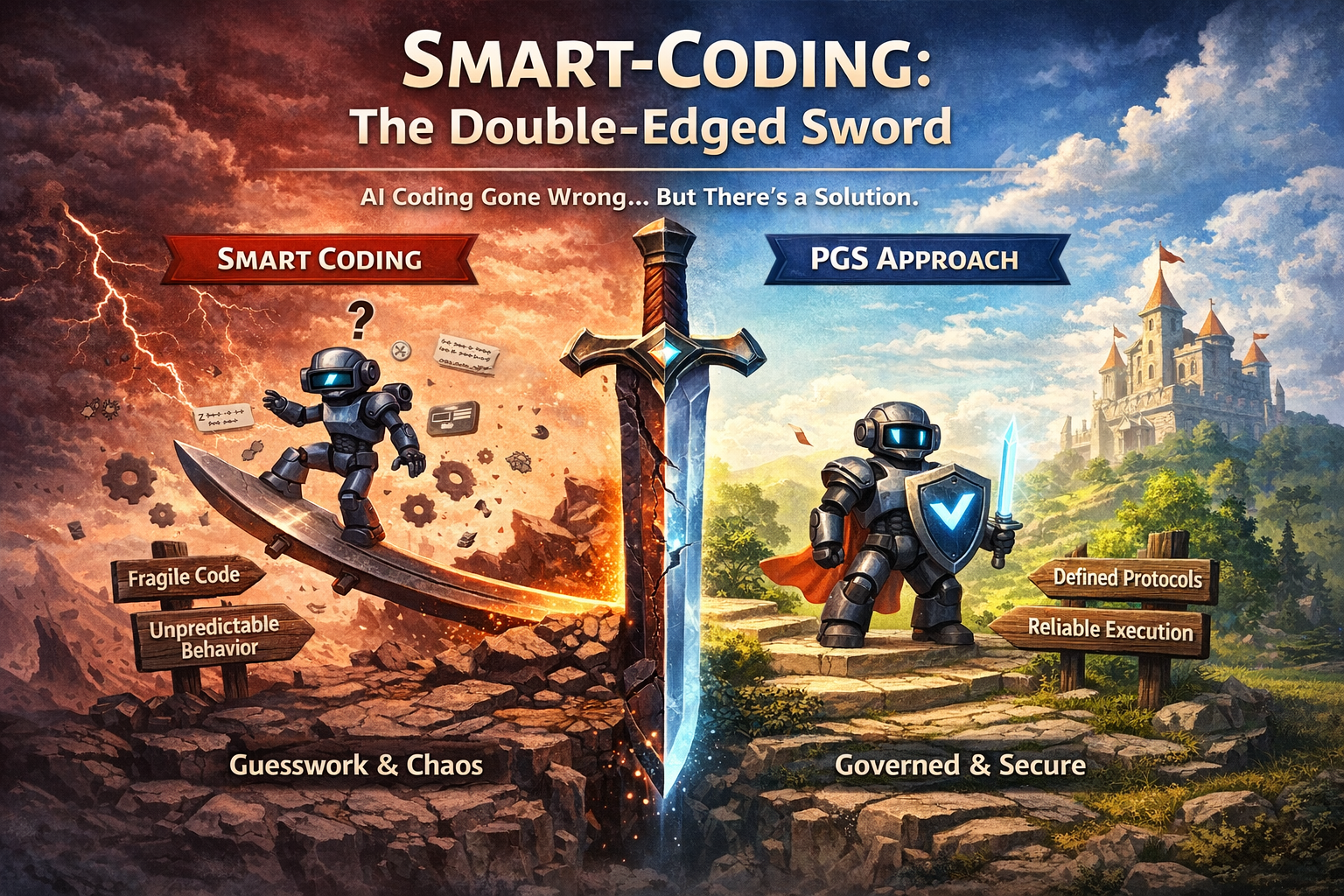
In the previous post, we explored how Protocol-Governed Systems deliver three structural dividends: governance, protocol reuse, and architectural clarity.
Those dividends become even more relevant when we examine how software is now being created.
Because today, a new force is reshaping development practice:
AI-assisted coding.
And with it, a concept that sounds entirely positive — but deserves closer examination:
Smart coding.
What Is “Smart Coding”?
Smart coding is the practice of writing software using:
- abstraction
- inference
- flexible patterns
- developer intuition
In traditional engineering, this has been a strength.
A skilled engineer:
- infers intent from context
- writes adaptive logic
- handles edge cases proactively
- builds systems that “just work”
This kind of intelligence embedded in code is often celebrated as craftsmanship.
And for a long time, it worked well.
What Is “AI Coding”?
AI coding extends that philosophy.
Instead of a human applying intuition, AI systems now:
- generate code from prompts
- infer missing details
- suggest patterns and fixes
- optimize for speed and completion
The result is powerful:
Software can now be produced at machine speed.
But there is a subtle shift happening beneath the surface.
Where the Double Edge Appears
Smart coding has always assumed something important:
The person writing the code understands the system.
AI fundamentally changes that assumption.
Now:
- code is generated faster than it can be reviewed
- intent is partially inferred, not fully declared
- behavior emerges from patterns, not explicit design
- assumptions multiply invisibly
In other words:
The system becomes implicitly defined.
This is where the edge flips.
The First Edge (Helpful)
Smart coding:
- reduces boilerplate
- accelerates development
- adapts to changing requirements
- enables rapid prototyping
This is the edge we celebrate — and rightly so.
For small systems, skilled teams, and well-understood domains, smart coding remains effective.
The Second Edge (Risky)
When scaled through AI:
- implicit assumptions multiply exponentially
- behavior becomes harder to reason about
- governance drifts away from execution
- correctness depends on interpretation
- edge cases compound silently
What used to be cleverness becomes:
Unbounded inference at machine speed.
And that is not a coding problem.
It is an architectural problem.
The Core Tension
From the previous post, we saw:
Software can now be generated faster than humans can govern it.
Smart coding amplifies that gap.
Because it relies on:
- inference instead of declaration
- flexibility instead of constraint
- intelligence inside code instead of structural governance
But effective governance requires the opposite:
- explicit rules
- deterministic behavior
- inspectable structure
- mechanical validation
This mismatch creates what we call:
The generation–governance gap.
And AI is widening it every day.
A Different Approach: Protocol-Governed Systems (PGS)
Protocol-Governed Systems take a fundamentally different path.
Instead of making code smarter, they make execution governed.
What Is PGS?
PGS is an architectural approach where:
- system behavior is declared as protocol artifacts
- execution is driven by those declarations
- code becomes a mechanism, not a decision-maker
In practical terms:
- workflows define allowed behavior
- capability contracts define boundaries
- validation happens before execution
- violations are rejected, not handled
Why This Changes the Equation
Smart coding tries to improve how code behaves.
PGS changes where behavior is defined.
In a Smart Coding Model
- behavior lives in code
- correctness depends on interpretation
- safety depends on discipline
- governance is procedural
In a PGS Model
- behavior lives in protocol
- correctness is validated structurally
- safety is enforced mechanically
- governance is architectural
The difference is subtle but profound.
Reframing the Role of AI
This is not an argument against AI coding.
In fact, AI becomes more powerful in a governed model.
Without Governance
AI:
- generates code with implicit assumptions
- introduces hidden variability
- compounds complexity invisibly
- makes systems harder to reason about
With Protocol Governance
AI can:
- generate workflows safely within defined boundaries
- compose capabilities inside enforceable constraints
- operate at machine speed without sacrificing correctness
- amplify engineering velocity without amplifying risk
Instead of amplifying risk, AI becomes a controlled accelerator.
That is the opportunity most organizations are missing.
The Real Insight
Smart coding is not wrong.
It is simply incomplete at scale.
It works effectively when:
- systems are small
- developers share context
- behavior is manageable
- change is gradual
But in the AI era:
Inference scales faster than understanding.
And that is where architecture must evolve.
From Smart Code to Governed Execution
The shift is subtle but critical:
- from intelligent code
- to explicitly governed systems
This does not eliminate flexibility.
It relocates it:
- from hidden logic
- to visible, enforceable structure
The result is systems that are both:
- evolvable (behavior can change through protocol)
- governable (constraints are enforced mechanically)
That combination becomes essential as AI accelerates.
What Comes Next
If we accept that:
- AI will continue to accelerate code generation
- systems will continue to grow in complexity
- governance cannot remain procedural
Then the question is no longer:
“How do we write smarter code?”
It becomes:
“How do we constrain behavior without slowing innovation?”
Protocol-Governed Systems are one answer.
By moving governance from code into protocol, we create systems where:
- AI can generate safely
- domains can compose cleanly
- complexity scales linearly
- behavior remains deterministic
The Architectural Choice
We are at an inflection point.
AI coding tools are becoming exponentially more capable.
Organizations have two paths:
Path 1: Accelerate smart coding
- Generate code faster
- Rely on review processes
- Accept growing governance debt
- Hope discipline scales
Path 2: Adopt structural governance
- Declare behavior in protocol
- Enforce constraints mechanically
- Let AI operate within boundaries
- Scale governance architecturally
The first path is familiar.
The second path requires rethinking architecture.
But the second path is the one that scales.
Final Thought
Smart coding served us well in the human-speed era.
But machine-speed generation requires machine-speed governance.
That governance cannot live in code.
It must live in architecture.
Protocol-Governed Systems demonstrate how.
In the next post, we will explore how this structural governance is implemented through the Layer–Concern Constitutional Model, and how it enables large systems to evolve without losing control.
The PGS Series
- The architectural foundation (published)
- Defining PGS and OmniBachi (published)
- Agentic AI needs a constitution (published)
- Governing agentic AI for production (published)
- The quiet privilege escalation (published)
- From blog post to bounded runtime (published)
- From serverless guardrails to structural governance (published)
- The Three Dividends of Protocol-Governed Systems (published)
- Why Smart Coding Is a Double-Edged Sword (this post)
- The Layer-Concern Constitutional Model
- Governance and authoring mechanics
- Deterministic enforcement and trace conformance
- Vocabulary-bounded security
- The generation–governance gap in the AI era
These ideas are explored in depth in the upcoming book: Protocol-Governed Systems: Architecture for the AI Era
The book includes a working reference implementation called OmniBachi, demonstrating how protocol governance can be enforced mechanically.
— Bhash Ganti (aka Bachi) OmniBachi™ Initiative
LinkedIn Teaser
Really appreciate this thread — bringing mathematical rigor into software execution is long overdue.
LeanFRO’s focus on proving correctness after execution is a powerful step forward. It raises the bar from “works in practice” to “can be verified in principle.”
But AI-driven development is changing the timing of the problem.
When code is generated at machine speed, even provable correctness after the fact can become a bottleneck. The question then becomes:
Can we shift correctness earlier — before execution even begins?
One approach we’ve been exploring is protocol-first architecture:
- behavior is declared explicitly (workflows, intents)
- side-effects are enumerated as contracts
- execution is constrained to what the protocol permits
In that model:
Correctness isn’t just proven — it’s structurally enforced upfront.
Which creates an interesting complement to LeanFRO:
- LeanFRO → proves correctness of execution
- Protocol-first → constrains what can be executed
Together, this opens the door to systems where correctness is both pre-guaranteed and post-verifiable.
Curious how the LeanFRO community sees this “shift-left” of correctness.
I wrote a short piece expanding on this idea in the context of AI coding:
👉 [link to blog]