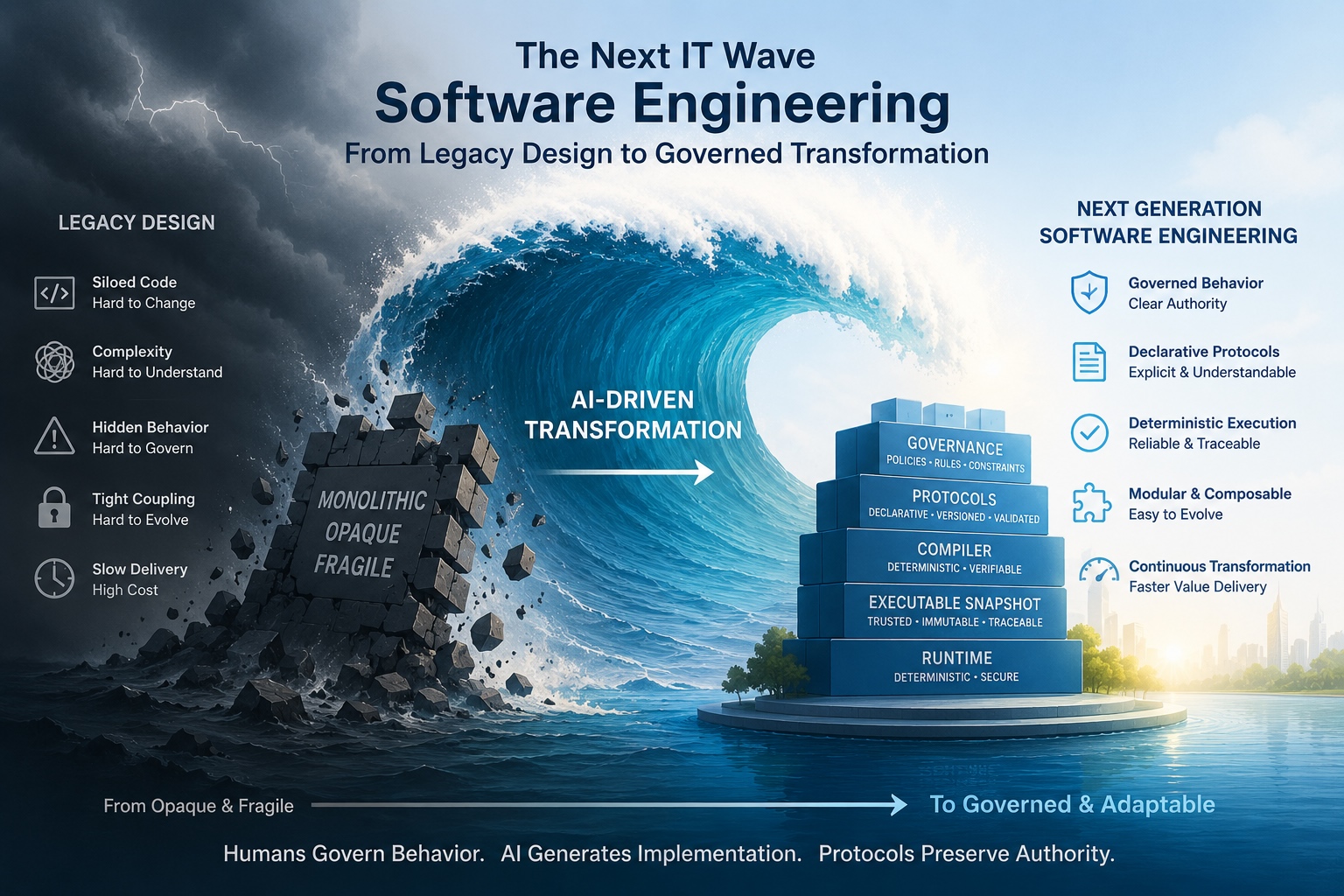
The new millennium entered adolescence after the Dotcom Bust, followed by waves of Cloud Computing, Mobile/Social Networking, and now, the AI boom. Each wave followed roughly a ten-year cycle, and the next one is already written on the wall in invisible ink, if you only connect the dots.
The next great IT wave may not be CapEx-rich Quantum Computing. It may have to be some OpEx-rich wave, perhaps Software Engineering?. That is if you believe AI will survive and thrive unlike Dotcom bust.
1. The Perfect Storm
Every major IT wave is born from a perfect storm of three converging forces: a pressing problem, financial resources, and human resources. Today, all three are converging on software engineering.
The Pressing Problem: Software Governance
The most successful application of AI is code generation. Systems like OpenAI’s ChatGPT and Anthropic’s Claude and comparable products are generating code at a staggering rate. This creates an urgent operational crisis: Software Governance. As AI generates software faster than humans can review it, how do we retain authority over what the code is allowed to do? The challenge is no longer just writing code, but governing its behavior. We have covered these in previous twenty blogs.
The Financial Engine: AI Must Generate Value
The AI boom is fueled by enormous capital investment in data centers, chips, and energy. To avoid an “AI Bust,” this investment must generate massive revenue, almost ten times its current rate. The killer app for AI isn’t just creating new software; it’s transforming existing software. By enabling the virtual rewriting of the world’s legacy business software, AI can unlock a multi-trillion-dollar market, turning its token-burning engine into a fire hydrant of revenue.
The Human Opportunity: From Implementation to Governance
The rise of AI doesn’t mean the end of developers. It signals a shift in their role. As AI handles implementation, human resources can be redeployed to a higher level of abstraction: defining and governing software behavior, business logic, and rules. This creates an opportunity to build new software for finance, healthcare, government services, e-commerce, insurance industry etc. at a scale never before possible, with humans guiding the “what” and AI handling the “how.” So what is stopping us? Short answer – our current model of software engineering.
2. The Next Wave: A New Computing Model
The current crisis stems from our decades-old computing model. We have built our systems on the Imperative Turing Machine, where behavior is a side effect of a sequence of low-level instructions. To govern AI-generated code, we need a new model. Move over imperative coding of business rules, here comes declarative authoring.
The next wave is the Declarative Protocol-Governed Machine.
Here’s a brief comparison:
| Imperative Turing Machine (Old Wave) | Declarative Protocol-Governed Machine (Next Wave) | |
|---|---|---|
| Core Idea | Tell the machine how to do something. | Declare what behavior is authorized to exist. |
| Process | Program → Instructions → Execution → Behavior | Intent → Governed Behavior → Protocol → Compiler → Execution |
| Authority | Lives in the source code, mixed with implementation. | Lives in a separate, governed protocol that is compiled. |
| Result | Behavior is an emergent property of the implementation. | Behavior is deterministic and guaranteed by the protocol. |
In this new model, the implementation (code) is generated by AI but is constrained by a human-governed protocol. The protocol, not the code, is the source of truth. An AI can regenerate the implementation, but the governed behavior remains unchanged.
The Future is Governed Software
The next wave of software engineering is about inverting our model. We are moving from an era where the primary artifact was Source Code to one where it is Governed Behavior.
AI is the catalyst, not the destination. It makes implementation abundant, forcing us to finally answer the question: Where does authority over software behavior live?
If the answer remains “somewhere in the code,” we are headed for a crisis of ungovernable systems. If the answer is “in an explicit, governed protocol,” we unlock a future of human-governed, AI-implemented software.
The age of software engineering is not ending. It is finally beginning.
Documentation and Reference Implementation
Curious what is Protocol-Governed computing is? Read all about it at:
Now you want see what it looks like? Go to: