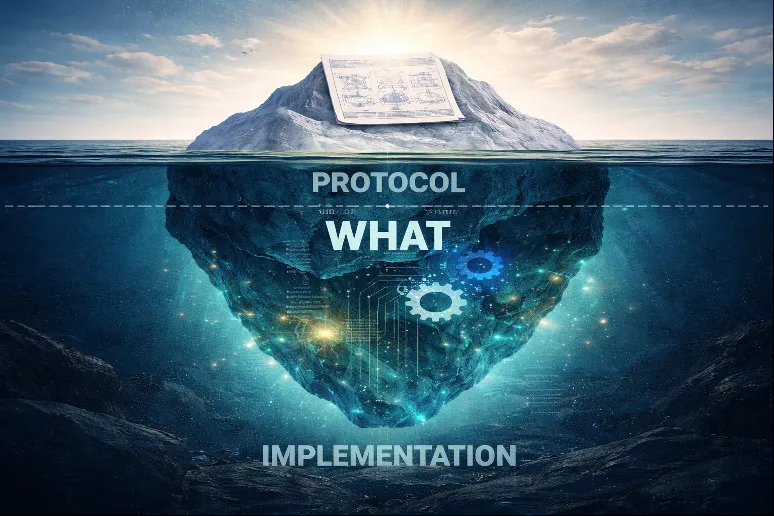
Separating What Is Dispensable from What Must Endure
Software is changing faster than we can understand it.
AI can now generate production-quality code at speeds that dwarf human output. Entire features can be scaffolded in minutes. Refactors that once took weeks are completed in seconds.
But there is a growing problem hiding beneath that productivity surge:
We no longer know, with confidence, what our systems actually do.
When someone asks, “What does this system do?” the answer usually requires reading thousands of lines of code. Business rules, constraints, edge cases, compliance logic — all of it is embedded inside implementation details.
Code has become the specification.
And that is a fragile place to be — especially in the AI era.
The Core Problem
Traditional software systems mix two fundamentally different things:
WHAT the system must do (business rules, constraints, policies, invariants)
HOW the system does it (programming language, optimization strategy, architecture, deployment model)
These are not the same.
And yet, in most systems, they are inseparable.
When AI generates or modifies code, it changes the “how.” But because the “what” is buried inside the same code, we risk subtle semantic drift. Tests may pass. The application may run. But behavior may have shifted in small, meaningful ways.
Over time, systems become difficult to audit, difficult to evolve, and difficult to trust.
This is the motivation behind Protocol-Governed Systems (PGS).
What Is a Protocol-Governed System?
A Protocol-Governed System separates system behavior from implementation mechanics.
In a PGS:
System behavior is declared explicitly in versioned protocol artifacts.
Execution engines interpret those artifacts deterministically.
Implementation code becomes replaceable.
Behavior becomes inspectable.
Conformance becomes mechanically verifiable.
In other words:
The protocol defines what the system does.
The engine defines how it does it.
And the two are constitutionally separated.
A Useful Analogy
This pattern is not new to technology.
Industrial control systems have followed it for decades. A programmable logic controller (PLC) runs generic hardware. The process behavior is defined in ladder logic programs. If the manufacturing process changes, engineers modify the logic — not the controller hardware.
Operating systems follow the same pattern. Applications declare requirements. The OS provides execution services. You do not redesign the operating system for every application.
Yet most business software still rebuilds its runtime infrastructure from scratch for each domain — embedding rules, policies, and invariants inside custom code.
Protocol-Governed Systems apply the same separation principle to business systems.
The Architectural Foundation
In Paper #1 of this series, we introduce the structural foundation of PGS.
The architecture is organized along two independent axes:
Layers (Human Perspective)
Layers describe how humans design and govern the system. They move from legislative intent to deterministic execution:
Authoring
Governance
Protocol
Execution
Capability Transforms
Capability Side Effects
Transport
Structure
Each layer has a clear responsibility. No layer bleeds into another.
Concerns (Machine Perspective)
Concerns describe how the machine understands behavior:
Actors
Intents
Workflows
Capability Contracts
Runtime Bindings
Transforms
Side Effects
Events
Transport Ingress
Transport Egress
Layers organize human design.
Concerns organize machine enforcement.
Keeping those two dimensions separate is not stylistic — it is structural.
Determinism and Conformance
A core property of PGS is determinism.
Given identical protocol artifacts and inputs, execution must produce equivalent observable outcomes. This is verified through trace-based conformance testing — not code inspection.
That means:
Execution engines can be replaced.
Optimizations can be applied.
AI-generated implementations can be adopted.
Platforms can evolve.
As long as trace equivalence holds, behavior remains authoritative.
The protocol, not the code, defines truth.
Why This Matters Now
AI will generate the majority of production code within this decade.
We cannot govern systems by reading code that AI rewrites continuously.
We need an authoritative behavioral layer that exists independently of implementation.
Protocol-Governed Systems provide that layer.
They make behavior explicit.
They bound the mutation surface.
They keep governance ahead of generation velocity.
The Full Series
This article introduces Paper #1 — the architectural foundation.
The full Protocol-Governed Systems (PGS) series explores:
The architectural foundation
Computational universality under governance
The Layer–Concern constitutional model
Governance and authoring mechanics
Protocol as behavioral law
Deterministic enforcement and trace conformance
Pure computation vs governed mutation
Vocabulary-bounded security
Lifecycle economics and complexity scaling
The Generation–Governance Impedance Mismatch in the AI era
Together, these papers describe a complete governance architecture for systems that must remain stable, auditable, and evolvable in a world of accelerating implementation change.
OmniBachi™: A Reference Implementation
OmniBachi is a standards corpus and reference implementation of the Protocol-Governed Systems model.
It demonstrates that:
Declarative protocol artifacts can fully govern execution.
Deterministic conformance is practical.
Capability transforms and side effects can be constitutionally separated.
Behavioral authority can remain stable across engine evolution.
OmniBachi is not “another framework.”
It is a working instantiation of a standardized protocol-governed architecture.
For more information about OmniBachi or collaboration inquiries, contact the author directly.
A New Architectural Baseline
Protocol-Governed Systems are not a trend.
They are a response to an inevitable shift:
When implementation changes faster than governance can track, behavior must be separated from code.
PGS is that separation.
The series begins with the foundation.
And from there, we build upward.
Can’t wait? Want to see this in action?
Contact me if you want a copy of the technical paper#1:
***"*Protocol-Governed Systems: An Architectural Foundation for the AI
Era"
— Bachi
Contact: bachipeachy@gmail.com