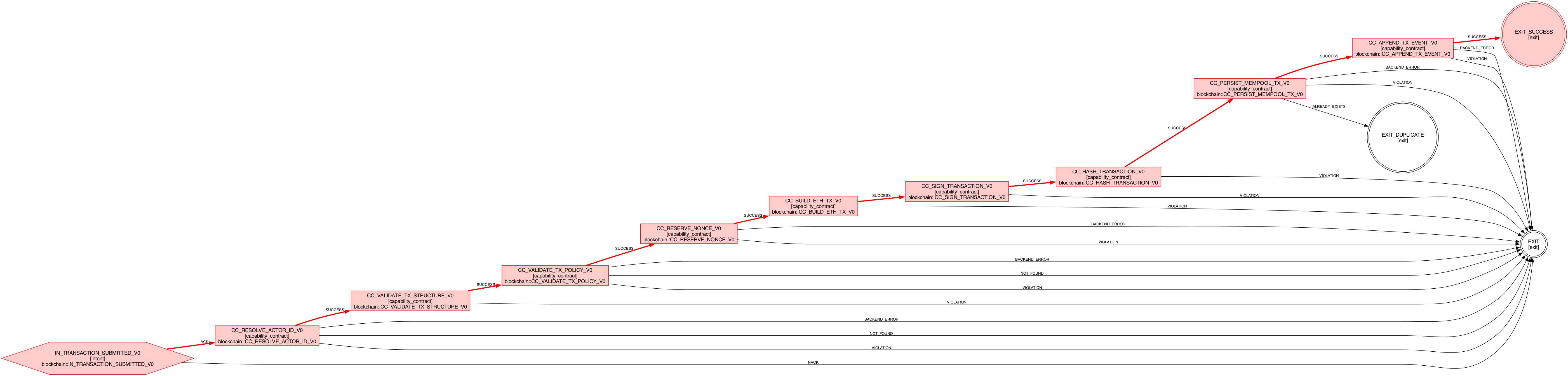
Following a single blockchain transaction through the execution topology of Protocol-Governed Systems (PGS)
In the previous post, we examined why the EU AI Act turns governance into an architectural problem — and why post-hoc monitoring cannot provide structural evidence of governed execution.
That discussion was conceptual.
This one is operational.
Because eventually every architectural claim has to answer a simple question:
“Show me what actually happens.”
So let’s do exactly that.
We will follow a single blockchain transaction through a live Protocol-Governed Systems (PGS) execution trace and examine what governance looks like under the covers.
Not policy documents.
Not architecture diagrams.
Actual execution topology.
The Traditional Black Box
In most systems, submitting a blockchain transaction appears deceptively simple:
submit_transaction(payload)
Underneath that call, dozens of things may happen:
identity resolution
authority checks
policy enforcement
nonce handling
cryptographic signing
hashing
persistence
event generation
error handling
But in conventional architectures, most of this behavior is:
implicit
framework-dependent
dynamically orchestrated
partially observable
operationally inferred after execution
Governance exists mostly in:
application logic
middleware
conventions
environment configuration
monitoring systems
human assumptions
The execution topology itself is rarely visible.
And more importantly:
the admissible execution space is rarely bounded before execution begins.
PGS approaches this differently.
The Reveal
The image below is not a debug trace.
It is not a sequence diagram manually drawn by an architect.
It is a real execution topology graph, generated directly by the PGS compiler from protocol artifacts. Every node, every branch, every failure exit was declared in protocol and compiled into a governed snapshot before a single line of runtime code executed.
This is what governed execution actually looks like.
At first glance, it may look like a workflow graph.
It is not.
It is something more restrictive:
an admissible execution topology.
Every node, branch, failure surface, and exit condition was declared in protocol, compiled into a snapshot, and admitted before runtime traversal began.
The runtime does not invent behavior dynamically.
It traverses admissible topology.
That distinction is the core inversion behind PGS.
The Full Execution Flow
The trace above is a real PGS execution topology for
blockchain::WF_SUBMIT_TRANSACTION_V0. It was compiled from protocol
artifacts and rendered by the PGS toolchain — not drawn by hand.
Here is the governed path this transaction traverses, step by step:
                        ┌──────────────────────────────┐
                        │  IN_TRANSACTION_SUBMITTED_V0 │  Intent Admission
                        └──────────────┬───────────────┘
                                  ACK  │
                                       ▼
                        ┌──────────────────────────────┐
                        │  CC_RESOLVE_ACTOR_ID_V0      │  Actor Resolution
                        └──────────────┬───────────────┘
                               SUCCESS │
                                       ▼
                        ┌──────────────────────────────┐
                        │  CC_VALIDATE_TX_STRUCTURE_V0 │  Structural Validation
                        └──────────────┬───────────────┘
                               SUCCESS │
                                       ▼
                        ┌──────────────────────────────┐
                        │  CC_VALIDATE_TX_POLICY_V0    │  Policy Governance
                        └──────────────┬───────────────┘
                               SUCCESS │
                                       ▼
                        ┌──────────────────────────────┐
                        │  CC_RESERVE_NONCE_V0         │  Nonce Reservation
                        └──────────────┬───────────────┘
                               SUCCESS │
                                       ▼
                        ┌──────────────────────────────┐
                        │  CC_BUILD_ETH_TX_V0          │  Transaction Assembly
                        └──────────────┬───────────────┘
                               SUCCESS │
                                       ▼
                        ┌──────────────────────────────┐
                        │  CC_SIGN_TRANSACTION_V0      │  Cryptographic Signing
                        └──────────────┬───────────────┘
                               SUCCESS │
                                       ▼
                        ┌──────────────────────────────┐
                        │  CC_HASH_TRANSACTION_V0      │  Transaction Hashing
                        └──────────────┬───────────────┘
                               SUCCESS │
                                       ▼
                        ┌──────────────────────────────┐
                        │  CC_PERSIST_MEMPOOL_TX_V0    │  Governed Persistence
                        └──────────────┬───────────────┘
                               SUCCESS │
                                       ▼
                        ┌──────────────────────────────┐
                        │  CC_APPEND_TX_EVENT_V0       │  Trace Event Append
                        └──────────────┬───────────────┘
                               SUCCESS │
                                       ▼
                              ╔════════════════╗
                              ║  EXIT_SUCCESS  ║
                              ╚════════════════╝

  At every node, failure outcomes (VIOLATION, NOT_FOUND,
  BACKEND_ERROR, ALREADY_EXISTS) route to governed failure
  exits — never to undefined behavior.
This sequence is not:
dynamically discovered
framework-generated
middleware-composed
agent-planned at runtime
It already existed before execution began.
The compiler projected this topology from protocol artifacts into a bounded admissible execution surface.
The runtime simply traversed it.
That is the architectural shift.
Step 1 — Intent Admission
IN_TRANSACTION_SUBMITTED_V0
The execution begins with an admitted intent.
This is not merely:
an HTTP request
an RPC method
an API handler
It is a protocol-defined admission boundary.
The runtime first asks:
“Is this execution intent admissible under the compiled governance snapshot?”
Traditional systems usually assume execution first and validate afterward.
PGS reverses that.
Execution begins only after intent admission succeeds.
Step 2 — Actor Resolution
CC_RESOLVE_ACTOR_ID_V0
The runtime resolves the actor identity associated with the transaction.
Importantly:
authority is explicit
identity is declared
governance is structural
The system does not rely on:
ambient session trust
framework injection
implicit permissions
middleware conventions
Identity admission itself becomes governed topology.
Step 3 — Structural Validation
CC_VALIDATE_TX_STRUCTURE_V0
The payload structure is validated against declared protocol semantics.
Malformed transactions terminate immediately into governed failure exits.
This matters because in PGS:
invalid topology is not merely rejected —
it becomes inadmissible execution.
Notice the difference.
Traditional systems often allow malformed execution to travel deep into runtime behavior before exceptions occur.
PGS bounds the execution surface early.
Step 4 — Policy Validation
CC_VALIDATE_TX_POLICY_V0
This is where governance becomes visible.
The runtime is not asking:
“Can this code run?”
It is asking:
“Was this transaction declared admissible under policy topology before runtime?”
That distinction is profound.
Traditional policy systems usually:
monitor execution
filter outputs
intercept violations afterward
PGS instead governs:
- admissible execution itself.
The execution path literally does not continue unless governance admits it.
Step 5 — Nonce Reservation
CC_RESERVE_NONCE_V0
Now we cross into mutation territory.
Even here:
state mutation
ordering guarantees
replay boundaries
concurrency semantics
are governed through protocol-defined capability contracts.
Mutation is not ambient runtime behavior.
Mutation is admitted topology.
This becomes especially important in distributed systems where:
race conditions
replay attacks
duplicate execution
ordering ambiguity
all become governance concerns.
Step 6 — Transaction Assembly
CC_BUILD_ETH_TX_V0
Before signing can occur, the transaction must be assembled into its canonical form.
This step constructs the Ethereum transaction object from the validated and nonce-reserved inputs.
In PGS, even assembly is governed — the capability contract declares exactly what inputs are consumed and what output structure is produced. The runtime does not allow ad-hoc construction.
Step 7 — Transaction Signing
CC_SIGN_TRANSACTION_V0
Cryptographic signing executes through governed capability contracts.
The runtime does not dynamically discover arbitrary signing behavior.
The execution surface is already bounded.
This matters because:
cryptographic authority
signing scope
execution ordering
are all now inspectable before runtime execution begins.
Step 8 — Transaction Hashing
CC_HASH_TRANSACTION_V0
The signed transaction is hashed inside governed topology.
Even pure computation becomes:
bounded
inspectable
topology-constrained
rather than ambient application behavior.
The runtime remains intentionally simple:
traverse topology
invoke admitted capability
record governed outcome.
Step 9 — Persistence
CC_PERSIST_MEMPOOL_TX_V0
Only after:
admission
identity resolution
structure validation
policy validation
nonce reservation
transaction assembly
signing
hashing
does persistence become admissible.
That ordering was not decided dynamically.
It was compiled.
This is one of the deepest architectural shifts in PGS:
governance defines execution ordering before runtime traversal begins.
Step 10 — Trace Event Append
CC_APPEND_TX_EVENT_V0
Finally, the execution emits a governed trace event.
But this is not merely logging.
A PGS trace records:
admitted intent
authority chain
topology traversal
governed outcomes
failure surfaces
snapshot provenance
A PGS trace is not operational telemetry.
It is:
an admissibility attestation.
The trace proves:
governance preceded execution
execution remained inside bounded topology
undeclared paths were never traversed.
The Hidden Insight
The most important part of the image is not the success path.
It is the explicit failure topology.
Notice how:
VIOLATION
NOT_FOUND
BACKEND_ERROR
ALREADY_EXISTS
all terminate into governed exits.
Traditional systems usually focus governance on:
- successful execution
while:
exception handling
escalation
retries
failure propagation
remain partially implicit.
PGS governs failure semantics too.
An undeclared failure surface is itself a governance violation.
Why This Is Not “Just a Workflow Engine”
At this point, a reasonable question emerges:
“Isn’t this just orchestration?”
No.
A workflow engine orchestrates execution.
PGS governs admissibility.
That sounds subtle, but the architectural difference is enormous.
Workflow systems typically:
coordinate execution
route tasks
manage retries
sequence operations
But the execution surface itself often remains open-ended.
PGS instead defines:
what execution paths may exist
what authority boundaries apply
what mutation surfaces are legal
what side effects are admissible
what failure exits are allowed
what topology may be traversed
before runtime execution begins.
The runtime becomes:
- topology traversal
not:
- behavioral improvisation.
Why This Matters for AI Systems
This distinction becomes dramatically more important for AI systems and autonomous agents.
As AI systems become:
more autonomous
more compositional
more tool-capable
more distributed
the execution surface expands rapidly.
Traditional architectures attempt to govern this expansion through:
prompts
middleware
monitoring
output filtering
policy overlays
But those approaches govern behavior after capability already exists.
PGS instead governs:
- admissible execution topology itself.
The execution path literally does not exist unless:
declared
compiled
admitted
bounded
before runtime execution begins.
That changes governance from:
- operational supervision
into:
- structural admissibility.
The Deeper Architectural Shift
The transaction trace reveals something larger than blockchain execution.
It reveals a different philosophy of software architecture.
Traditional systems generally assume:
execution is open
governance constrains behavior afterward
PGS inverts that:
governance constructs admissible execution first
runtime traversal happens inside it afterward
This is why PGS increasingly behaves less like:
a framework
oran orchestration engine
and more like:
- a constitutional execution substrate.
The blockchain trace is not merely a blockchain example.
It is the smallest visible expression of a much larger architectural direction.
The PGS Series
The architectural foundation (published)
Defining PGS and OmniBachi (published)
Agentic AI needs a constitution (published)
Governing agentic AI for production (published)
The quiet privilege escalation (published)
From blog post to bounded runtime (published)
From serverless guardrails to structural governance (published)
The Three Dividends of Protocol-Governed Systems (published)
Why Smart Coding Is a Double-Edged Sword (published)
AI Accelerated Implementation. Not Governance. (published)
The EU AI Act Is Here. Your Governance Architecture Isn’t Ready. (published)
What Actually Happens Inside a Protocol-Governed Execution (this post)
These ideas are explored in depth in the upcoming book:
Protocol-Governed Systems: Architecture for the AI Era
The book includes a working reference implementation called OmniBachi, demonstrating how protocol governance can be enforced mechanically.
– Bhash Ganti (aka Bachi)
OmniBachi Initiative