In Part 3, we argued that agentic AI needs a constitution, not just guardrails. The core insight: the real enterprise risk is not hallucination — it is ambient authority, the implicit power agent frameworks grant to models without structural boundaries.
That post was about why.
This one is about how.
And we have a concrete protagonist: OpenClaw.
OpenClaw: The Agent Enterprises Want
OpenClaw is an open-source autonomous AI assistant that is catching fire in the developer community. It runs locally, uses Claude as its reasoning engine, and has capabilities that would have seemed science fiction two years ago:
Full system access — file management, shell commands, script execution
Browser automation — web navigation, data extraction, form submission
50+ service integrations — Gmail, GitHub, Slack, Spotify, Obsidian, and growing
Persistent memory — learns user preferences and context across sessions
Self-extending skills — it can write its own capabilities via ClawHub
OpenClaw is powerful precisely because it has broad authority. It can read your files, execute commands, navigate the web, send messages, and modify state across dozens of systems — autonomously.
For an individual developer, that is transformative.
For an enterprise, that is a risk profile.
The Enterprise Paradox
Every enterprise technology leader sees the same thing: agentic AI like OpenClaw can automate operations that currently require entire teams — license provisioning, compliance workflows, infrastructure management, vendor coordination.
The capability is real. The ROI is obvious.
But the moment an OpenClaw-class agent can:
Provision user accounts in your identity system
Allocate budget across cost centers
Modify compliance records
Trigger contractual obligations with vendors
Execute shell commands on production infrastructure
…every CISO, compliance officer, and auditor asks the same questions:
What authority does this agent operate under?
Can we prove it never exceeded that authority?
Can we replay what it did — deterministically?
Can we bound the damage if it goes wrong?
OpenClaw was not designed to answer these questions. No agent framework was. They are optimized for capability and flexibility — not for declared authority, deterministic audit, and blast-radius containment.
That is not a criticism. It is a statement of architectural scope.
The governance problem belongs to a different layer.
The Architecture: A Constitutional Layer Between Agent and Enterprise
The solution is not to cripple OpenClaw. Its broad capability is the whole point.
The solution is to introduce a constitutional governance layer between the agent and the enterprise systems it touches.
Instead of:
OpenClaw → Tool → System → (Log)
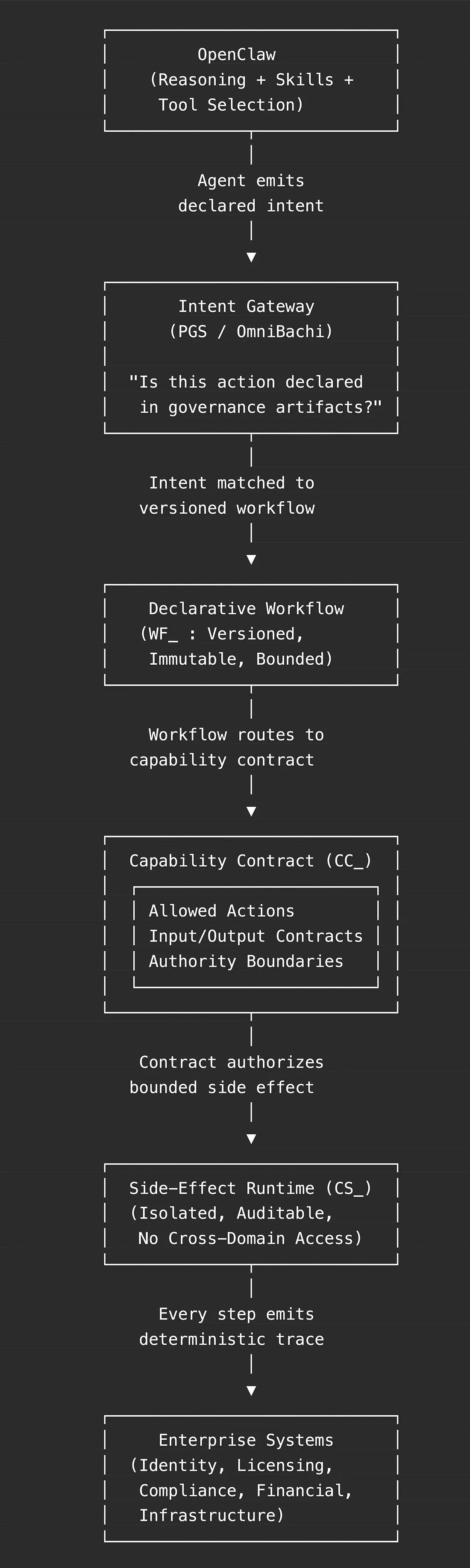
The execution path becomes:
OpenClaw → Declared Intent → Governed Workflow → Capability Contract → Bound Runtime → Deterministic Trace
The agent proposes. The governance layer decides. The enterprise system executes only what is declared.
Figure 1. Constitutional governance layer between OpenClaw and
enterprise
systems.
OpenClaw handles reasoning, memory, and skill selection. PGS/OmniBachi handles authority, isolation, and deterministic trace. Neither replaces the other.
A Concrete Scenario: OpenClaw Managing Enterprise Licenses
Make this real. A large enterprise deploys an OpenClaw-based agent to manage software license allocation across 10,000 seats.
Without the governance layer:
OpenClaw receives a request: “Provision 200 premium licenses for the APAC engineering team.”
It uses its skills to call the license management API. It selects parameters based on context. It provisions the seats. It logs what it did.
Three weeks later, an audit reveals 200 premium seats were allocated when the APAC team was only authorized for standard tier. The cost difference: $400,000 annually.
The investigation begins. Log files are aggregated. The agent’s reasoning is reconstructed from traces. Nobody can definitively answer: Was the agent authorized to allocate premium seats?
Because the answer was never declared. It was inferred.
With PGS/OmniBachi as the governance layer:
OpenClaw receives the same request. It emits a declared intent: IN_ALLOCATE_LICENSE.
The intent hits the PGS gateway. A workflow (WF_LICENSE_ALLOCATION_V0) routes it through declared steps. A capability contract (CC_PROVISION_LICENSE_V0) specifies: APAC engineering is authorized for standard tier only, maximum 500 seats per request.
The premium allocation is structurally rejected. Not filtered. Not flagged for review. Rejected — because the governance artifact does not declare it.
OpenClaw is informed. It can propose an alternative within declared bounds. Or escalate to a human with the specific constraint that blocked it.
The $400,000 mistake never happens. Not because someone caught it — but because the architecture made it impossible.
What Changes — Concretely
The difference is not degree. It is kind.
One system hopes the agent behaves. The other makes misbehavior architecturally impossible.
Five Enterprise Guarantees
For CISOs, compliance officers, and architects evaluating agentic AI for production, the governance layer provides five structural guarantees:
1. Contained Authority
No ambient authority. OpenClaw’s broad skill set is channeled through declared governance artifacts. The agent cannot invoke capabilities that are not versioned and authorized. Authority is explicitly granted, not assumed.
2. Bounded Blast Radius
An agent authorized to read license records cannot write compliance state. An agent authorized for standard-tier provisioning cannot allocate premium seats. Cross-domain coupling is structurally prohibited, not policy-filtered.
3. Deterministic Auditability
Every execution produces a structured, tamper-evident trace — not a log line, a complete execution record. When the auditor asks “What happened and what was it authorized to do?”, the answer is deterministic and replayable.
4. Versioned Governance
Agent capabilities are version-bound. V1 and V2 of a capability contract coexist without conflict. New authority is additive. Old authority remains stable. There is no drift.
5. Compliance as Output
Audit artifacts are structural outputs of every execution — not afterthoughts assembled for quarterly reviews. The system does not support compliance. It produces compliance as a byproduct of governed execution.
Strategic Positioning: Complementary, Not Competing
This is worth stating clearly:
PGS/OmniBachi is not a replacement for OpenClaw. OpenClaw’s reasoning, memory, skill extensibility, and broad integration surface are exactly what enterprises need for autonomous operations.
PGS/OmniBachi is the governance substrate that makes OpenClaw enterprise-ready.
OpenClaw answers: What can the agent do?
PGS/OmniBachi answers: What is the agent authorized to do?
Open frameworks accelerate innovation.
Governed execution enables production.
These are complementary layers — and both are required.
Who Needs This
Any organization deploying agentic AI into:
Regulated industries — financial services, healthcare, insurance, where every action must be auditable and authority provable.
Large enterprises — where blast radius, cross-domain coupling, and change coordination are existential concerns.
Public sector — where authority must be declared, not inferred.
Any system where AI holds production authority — provisioning, allocation, approval, compliance, infrastructure.
If the agent can touch systems that matter, governance is not optional.
Why Now
Agentic AI is moving from experimentation to operational control faster than governance teams can respond. OpenClaw’s trajectory is proof: the community is growing, the skills are multiplying, the integrations are expanding.
That acceleration is the opportunity and the risk.
As soon as an agent can touch identity systems, allocate financial resources, modify policy state, or execute compliance workflows — governance becomes non-optional.
Organizations that adopt structural authority boundaries early will:
Reduce coordination overhead — governance is declared once, not negotiated per deployment.
Simplify compliance posture — audit artifacts are automatic, not manually assembled.
Avoid retrofitting — adding governance after an incident is expensive, disruptive, and late.
The cost of governing early is architectural discipline.
The cost of governing late is incident response.
The Bottom Line
OpenClaw gives agents the capability to act autonomously across enterprise systems.
PGS/OmniBachi gives enterprises the guarantee that those actions are declared, bounded, isolated, and traceable.
Together, they convert probabilistic orchestration into deterministic infrastructure.
The agents are ready.
The question is whether the governance is.
The PGS Series
This article is Part 3b — a companion to Part 3. Here is the full series outline:
The architectural foundation (published)
Defining PGS and OmniBachi (published)
Agentic AI needs a constitution (published)
Governing agentic AI for production (this post)
The Layer-Concern constitutional model
Governance and authoring mechanics
Protocol as behavioral law
Deterministic enforcement and trace conformance
Pure computation vs governed mutation
Vocabulary-bounded security
Lifecycle economics and complexity scaling
The Generation-Governance Impedance Mismatch in the AI era
Want to see PGS in action? Technical papers and product briefings available upon request, starting with Paper #1: “Protocol-Governed Systems: An Architectural Foundation for the AI Era”
— Bachi
Contact: bachipeachy@gmail.com