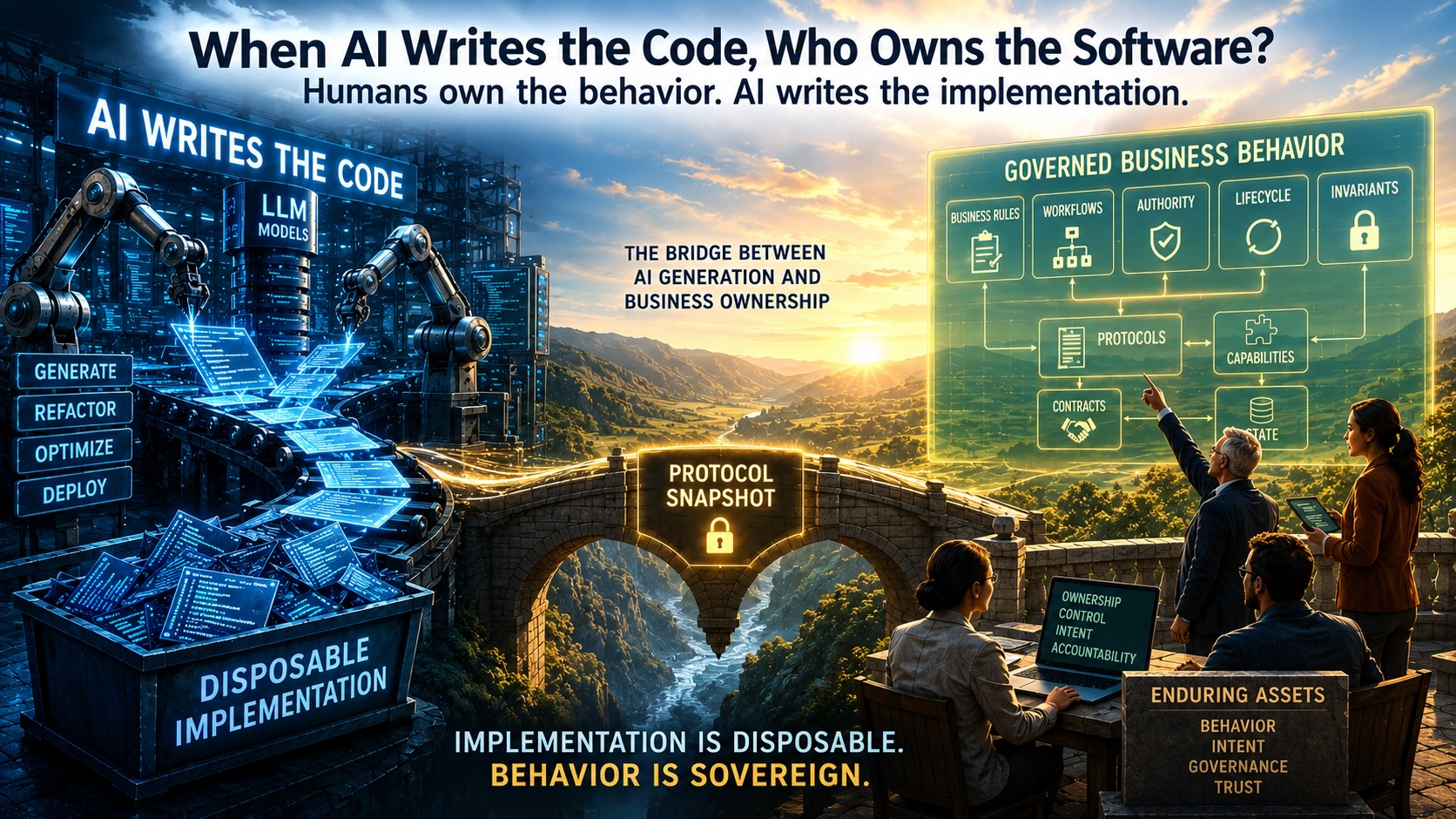
“The future of software engineering is not about humans writing more code. It is about humans governing what software is allowed to do.”
AI has changed the software equation. Something fundamental is happening in software engineering.
AI coding systems can now generate applications, refactor repositories, explain architectures, and produce implementations at a speed that was unimaginable only a few years ago.
The question dominating the industry has been:
“How soon will AI write all software?”
But that question misses the deeper architectural challenge.
The more important question is:
“If machines can generate implementation, what remains uniquely human?”
The answer is not syntax.
It is not programming languages.
It is not frameworks.
It is:
- business intent
- authority
- policies
- constraints
- invariants
- behavior
We have confused software with implementation
For decades, software systems bundled two fundamentally different things together:
   Business Behavior
          +
   Software Implementation
Implementation includes:
- programming languages
- algorithms
- frameworks
- APIs
- infrastructure
- deployment choices
Behavior includes:
- what the system is allowed to do
- who is authorized to do it
- when actions occur
- what rules must always remain true
These two things evolve at different speeds.
Yet we store them together.
We review them together.
We deploy them together.
We replace them together.
That coupling created much of the complexity we experience in modern software systems.
AI makes implementation abundant
Large language models are changing the economics of software creation.
Implementation is becoming increasingly easy to generate.
A system written in Python today may be regenerated tomorrow in Rust, Java, or an entirely different technology.
If implementation can continuously change, then implementation cannot be the permanent engineering artifact.
The question becomes:
What should survive every future implementation technology?
The answer: governed behavior
This question led to the architecture behind Protocol-Governed Systems (PGS).
PGS starts from a different premise:
Behavior should be a governed artifact. Implementation should be replaceable.
A protocol-governed system separates:
   Behavior
      from
   Implementation
Business behavior is expressed as governed protocols.
Implementation becomes a realization strategy.
Humans define and govern behavior.
Machines generate and optimize implementation.
Two architectural questions
Once behavior becomes the primary artifact, two fundamental questions emerge.
Question 1: How does behavior evolve?
Real software is never static.
Businesses change.
Rules change.
Processes change.
Systems must evolve.
But how can software change without losing governance?
This is the question answered by Paper 1: The Evolution Architecture — Protocol-Governed Systems: An Architecture for Closed-Loop Governed Transformation.
The central idea:
The enduring engineering artifact is not the implementation. It is the governed transformation that creates the new executable baseline.
The architecture describes how business intent becomes a validated, executable baseline through:
- governed change
- semantic enrichment
- validation
- construction
- admission
- promotion
The result is not simply new code.
It is a new governed behavior model.
Question 2: How does behavior execute?
Creating governed behavior is only half the problem.
Once that behavior exists, another question appears:
How do we ensure the machine executes only what was authorized?
This is the question answered by Paper 2: The Execution Architecture — Protocol-Governed Systems: An Architecture for Deterministic Declarative Execution.
The central idea:
The enduring execution artifact is the executable protocol. The runtime is merely its deterministic interpreter.
The architecture introduces a fundamental separation:
   Compiler
   (determines behavior)
       │
       ▼
   Executable Protocol
       │
       ▼
   Runtime
   (executes behavior)
The runtime does not invent behavior.
It does not create workflows.
It does not infer business rules.
It executes what was already declared, validated, and compiled.
A different software architecture for the AI era
Traditional software:
   Human
     │
     ▼
   Requirements
     │
     ▼
   Source Code
     │
     ▼
   Runtime
     │
     ▼
   Behavior
The AI-era architecture needs to become:
   Human
     │
     ▼
   Business Intent
     │
     ▼
   Governed Behavior
     │
     ▼
   Executable Protocol
     │
     ▼
   Generated Implementation
     │
     ▼
   Runtime
     │
     ▼
   Outcome
The critical change is ownership.
The machine may generate implementation.
The human retains ownership of behavior.
The new role of software engineers
This does not eliminate software engineering.
It changes its center of gravity.
The question moves from:
“How do we write this feature?”
to:
“What behavior should this system preserve?”
Human responsibility moves upward:
- defining business rules
- establishing authority
- governing change
- validating meaning
- protecting invariants
Machine responsibility moves downward:
- generating implementations
- optimizing execution
- adapting technology
- producing artifacts
Why this matters now
Without this separation, AI-generated software creates a dangerous possibility:
A world with millions of AI-generated systems where nobody clearly owns the behavior inside them.
The implementation may be excellent.
The system may run perfectly.
But the organization may no longer know:
- why it behaves that way
- who authorized that behavior
- whether it still reflects business intent
The risk is not that AI writes bad code.
The deeper risk is that humans lose ownership of what the code means.
The future of software engineering
For decades, source code was considered the primary engineering artifact.
AI challenges that assumption.
Perhaps source code was only one historical representation of something more fundamental:
governed business behavior.
As implementation becomes easier to generate, behavior becomes more valuable.
The scarce resource will not be code.
Code will become abundant.
The scarce resource will be trusted behavior.
Looking ahead
The transition to AI-driven software development will not be solved by better coding assistants alone.
It requires a new architectural foundation.
One where:
- humans govern meaning
- protocols preserve behavior
- compilers enforce rules
- runtimes execute deterministically
- implementations remain replaceable
The future of software engineering is not humans competing with machines to write code.
It is humans defining what software should do—and machines becoming extraordinarily capable at making it happen.
That is the architectural journey explored by Protocol-Governed Systems.
Architecture Papers
- Paper 1 — An Architecture for Closed-Loop Governed Transformation
- Paper 2 — An Architecture for Deterministic Declarative Execution