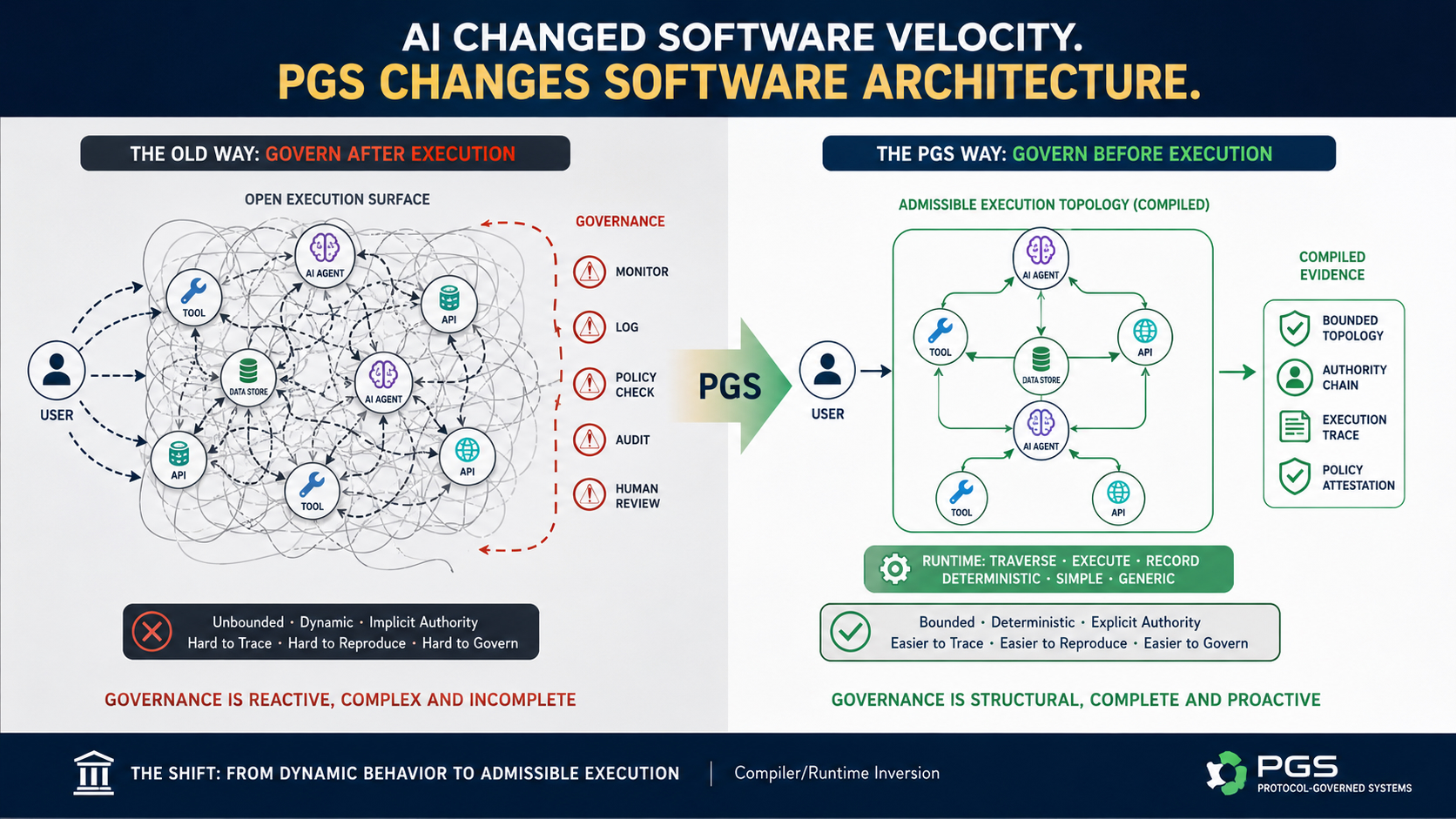
In the last few years, AI has dramatically accelerated software implementation velocity.
Code generation.
Agentic tooling.
Autonomous orchestration.
Self-modifying pipelines.
Framework-assisted composition.
Entire application layers can now be produced in hours instead of months.
But underneath this acceleration, a deeper architectural problem is emerging:
AI changed how fast we can build software.
It did not change how software is fundamentally governed.
And that distinction matters far more than most organizations currently realize.
Because the dominant software architecture model still assumes something increasingly dangerous in the AI era:
execution is open
governance constrains behavior afterward
PGS v0.3.0 marks a different direction.
Not merely a new runtime.
Not another orchestration engine.
Not another AI governance dashboard.
A deeper inversion.
An inversion in where architectural intelligence itself lives.
The Traditional Assumption
For decades, software architecture concentrated most operational intelligence inside the runtime:
frameworks dynamically discovered behavior
middleware injected authority
orchestration emerged during execution
services reconstructed topology at runtime
policy systems monitored execution afterward
governance remained largely procedural
The runtime became increasingly “smart.”
And the smarter runtimes became, the more difficult systems became to:
reason about
bound
reproduce
govern
audit
secure
formally attest
This problem existed before AI.
AI simply magnified it.
Because autonomous systems dramatically expand the execution surface.
AI Did Not Solve Governance
AI systems increasingly:
compose tools dynamically
orchestrate distributed capabilities
invoke side effects autonomously
chain execution paths probabilistically
operate across mutable execution environments
The industry response has mostly been:
prompts
middleware
monitoring
policy overlays
output filtering
human review loops
But these approaches still govern execution after capability already exists.
They supervise behavior operationally.
They do not structurally bound admissible execution itself.
That distinction is becoming critical.
Especially under increasing regulatory pressure from frameworks like the EU AI Act.
The PGS Shift
Protocol-Governed Systems (PGS) takes a different architectural position:
governance constructs admissible execution before runtime traversal begins.
This sounds subtle.
It is not.
Because it changes where intelligence lives inside the system.
Traditional systems generally behave like this:
Source Code
↓
Runtime reconstructs behavior dynamically
↓
Governance supervises afterward
PGS v0.3.0 now behaves more like this:
Protocol Governance
↓
Compiler materializes admissible execution topology
↓
Runtime traverses bounded topology deterministically
That is the inversion.
The Compiler/Runtime Inversion
PGS v0.3.0 introduces what may be the most important architectural milestone in the project so far:
Compiler/Runtime Inversion
The runtime is shrinking.
The compiler is becoming constitutional.
Instead of dynamically reconstructing orchestration during execution, the compiler now materializes:
admissible topology
execution routing
authority boundaries
failure surfaces
side-effect bindings
mutation ordering
governance invariants
before runtime execution begins.
The runtime no longer “figures out” behavior dynamically.
It traverses admissible topology.
What Changed in v0.3.0
The v0.3.0 public release introduces a token-native execution model.
The runtime no longer operates primarily on symbolic protocol structures.
Instead, the compiler emits fully materialized execution snapshots:
integer-addressed topology
dispatch routing tables
capability handler bindings
deterministic execution projections
bounded governance surfaces
The runtime became intentionally simple:
load snapshot
traverse topology
invoke admitted capability
record governed outcome
That simplicity is not a limitation.
It is the architectural goal.
The Runtime Became Blind
One of the most important properties of the new runtime is this:
the runtime no longer needs to understand governance semantics.
It does not load protocol artifacts.
It does not dynamically discover topology.
It does not reconstruct orchestration.
It does not interpret architecture.
It consumes a governed snapshot already compiled into admissible execution form.
This dramatically reduces:
hidden runtime behavior
implicit orchestration
heuristic execution
dynamic topology ambiguity
governance leakage
The execution substrate becomes increasingly generic.
And that turns out to matter enormously.
The Governance Dividend
During the v0.3.0 transition, a foundational identity model change was introduced across the system.
Historically, this type of change would typically ripple through:
execution engines
workflows
runtime bindings
service layers
orchestration code
domain implementations
Instead, the change required touching only:
artifact discovery
normalization
materialization
loading boundary
governance declaration
plus one new STRUCTURE artifact.
The execution layer itself remained largely untouched.
That is not normal software behavior.
That is architectural leverage.
The reason this worked is important:
protocol-first declaration
compile-time resolution
strict separation of concerns
no fallback heuristics
no ambient authority
no implicit discovery
The result:
PGS became extensible by declaration, not refactor.
That is the inflection point.
Change Management Without the Release Drama
ITIL 2.0 treats Release Management as a major discipline for good reason.
In traditional systems, change is expensive and risky.
A single behavioral change typically requires:
Change Advisory Board (CAB) approvals
bundled release packages coordinating multiple teams
freeze windows that block other work
rollback plans and contingency procedures
cross-system regression test suites
impact assessments across services
weeks of coordination before anything ships
Why all this ceremony?
Because change in traditional architectures is not bounded.
A change to one service ripples through call sites, configuration, orchestration, and integration layers.
Nobody knows exactly what breaks until it does.
PGS takes a structurally different position.
Every artifact carries an immutable version suffix:
WF_REGISTER_ACTOR_UNVERIFIED_V0CC_GENERATE_ACTOR_ID_V0CT_PURE_GENERATE_ID_V0
A change is not a release package.
A change is a new artifact.
CT_PURE_GENERATE_ID_V1 and CT_PURE_GENERATE_ID_V0 co-exist in the
registry.
Workflows that reference V0 continue unaffected.
New workflows can reference V1.
No forced migration. No coordinated cutover. No freeze window.
The change surface is bounded at declaration time.
That changes what release management means:
no bundled packages crossing team boundaries
no freeze windows
no regression risk from a change that does not touch your artifact
no cross-team coordination to adopt a change
no rollback plan — the old version was never removed
This is divide and conquer applied to change itself.
Each artifact is sovereign.
Each change is bounded.
Each adoption is independent.
The v0.3.0 identity model rename illustrated this at platform scale. In a conventional system, renaming a foundational identity concept would require a coordinated multi-team release: workflows, service layers, orchestration bindings, runtime assumptions — all moving together.
In PGS, the change touched artifact discovery, normalization, and the loading boundary.
The execution layer was untouched.
Existing workflows ran without modification.
The change was absorbed structurally, not propagated operationally.
ITIL makes Release Management a formal discipline because architectures make change expensive.
PGS makes change management a non-event because the architecture bounds change at the artifact.
Why This Matters for AI Systems
As AI systems become increasingly autonomous, the execution surface expands rapidly.
Traditional architectures attempt to govern this expansion operationally.
PGS instead governs:
the admissible orchestration surface itself
before runtime begins.
This changes governance from:
post-hoc supervision
into:
structural admissibility
The distinction becomes profound in agentic systems.
An AI system operating inside a PGS-governed workflow may still reason probabilistically internally.
But the execution topology through which its outputs become admissible actions is structurally bounded before traversal begins.
That changes the governance conversation entirely.
The Runtime Is Shrinking
One of the clearest signals emerging from PGS v0.3.0 is this:
more intelligence is moving toward compile-time governance.
Less intelligence is remaining in runtime execution.
That is deeply countercultural to modern software architecture.
Most systems have evolved toward increasingly intelligent runtimes:
dynamic frameworks
adaptive middleware
reflective orchestration
runtime inference
behavioral discovery
PGS moves in the opposite direction.
The runtime becomes smaller.
The compiler becomes more constitutional.
What Was Released
The PGS v0.3.0 public release now includes:
pgs_runtime — token-native deterministic execution runtime
pgs_compiler — governance-driven topology compiler
updated public repositories under Apache-2.0
tokenized snapshot architecture
deterministic admissibility traversal
Compiler/Runtime Inversion baseline
This release replaces the earlier OmniBachi v0.2.x symbolic runtime lineage with a structurally simpler and more bounded execution substrate.
The architectural direction is now substantially clearer.
The Deeper Shift
The most important insight from v0.3.0 is not tokenization.
It is not performance.
It is not packaging.
It is not orchestration.
The deeper shift is this:
governance is moving ahead of execution.
That may ultimately become one of the defining architectural changes required for governable AI systems at scale.
Because increasingly autonomous systems cannot rely indefinitely on:
procedural supervision
observational governance
implicit authority
dynamically reconstructed topology
The execution surface itself must become structurally governable.
PGS is one attempt at that direction.
The Open-Source Release
The Protocol-Governed Systems reference implementation is now publicly available:
Runtime: pip install pgs_runtime
Compiler: pip install pgs_compiler
GitHub repositories:
pgs_workspace (anchor repo) https://github.com/protocol-governed-computing
pgs_runtime
pgs_compiler
pgs_governance
All released under Apache-2.0.
What Comes Next
PGS is still early.
Many important areas remain ahead:
authoring systems
governance UX
distributed execution
federated trust
evidence verification
AI governance conformance frameworks
visualization tooling
snapshot signing and attestation
But v0.3.0 marks an important threshold.
The architecture is no longer merely conceptual.
The inversion is now mechanically demonstrable.
Final Thought
AI may dramatically accelerate implementation velocity.
But velocity alone does not solve governance.
And velocity alone does not solve change management.
PGS v0.3.0 represents a different architectural bet:
that the future of governed AI systems will depend less on smarter
runtimes and release coordination ceremonies
and more on admissible execution and atomic artifact change constructed
before runtime begins.
The Compiler/Runtime Inversion has only begun.
The PGS Series
The architectural foundation (published)
Defining PGS and OmniBachi (published)
Agentic AI needs a constitution (published)
Governing agentic AI for production (published)
The quiet privilege escalation (published)
From blog post to bounded runtime (published)
From serverless guardrails to structural governance (published)
The Three Dividends of Protocol-Governed Systems (published)
Why Smart Coding Is a Double-Edged Sword (published)
AI Accelerated Implementation. Not Governance. (published)
The EU AI Act Is Here. Your Governance Architecture Isn’t Ready. (published)
What Actually Happens Inside a Protocol-Governed Execution (published)
AI Changed Software Velocity. PGS Changes Software Architecture (this post)
— Bhash Ganti (aka Bachi)
Protocol-Governed Systems Initiative